Category Archives: FAQs

How Do You Qualify for an Auto Loan?

The used car buying process can feel intimidating, especially when it comes to financing. It can be easier to focus on things like the color, make or model rather than the most irksome aspect of buying a car — how we plan to pay for it.

Perhaps you’ve saved up enough cash to purchase the vehicle outright, greatly simplifying the payment process. Most Easterns Automotive shoppers aren’t in that position. In many cases car buyers come to us with just enough to make a down payment.

Qualifying for an auto loan in the Washington D.C. and Baltimore areas will require you to approach a lender(s) or dealership with a multitude of paperwork and documentation. Lenders will need to confirm things like your identity, employment, credit score and income before they can offer you a car loan.

What Materials Do You Need to Apply for an Auto Loan?

  1. Proof of identity (i.e., driver’s license or government-issued I.D.)
  2. Proof of income (i.e., bank statements or pay stubs)
  3. Credit and banking history
  4. Proof of residence (i.e., utility bill or mortgage statement)
  5. Vehicle information (i.e., purchase price and VIN number)

Where Do You Apply for an Auto Loan?

There are a number of lenders in DC, Maryland and Virginia who can offer you a loan to finance a used car purchase. When applying for auto loans, some car buyers will shop around for lenders until they find the best offer.

Common used car loan providers include:

  • National banks
  • Local community banks or credit unions
  • Online lenders who specialize in auto loans
  • Dealerships

What Is Pre-Qualification Versus Pre-Approval?

Pre-qualification is an estimate of the loan and rate you are likely to get based on the limited personal information and credit history you provide to a lender. A pre-qualification only requires a soft credit pull and is not an actual offer to fund your used car purchase.

Pre-approval is when a lender reviews your credit report to determine the estimated loan amount you’re approved to borrow and the interest rate you’ll be charged. A pre-approval does require a hard credit pull in order to provide a more accurate offer.

It’s important to note that neither will guarantee the approval of your auto loan, but both can be useful for planning and budgeting your used car purchase. If you want to impress a dealer or seller, getting pre-approved demonstrates your ability to obtain financing and shows you’re serious about buying the car.

What Affects the Approval of Your Auto Loan?

If you’re planning on financing your used car, you might be wondering what it takes to qualify for a car loan. If you haven’t had credit cards or loans in the past, you may have a harder time getting a loan.

Don’t lose hope — it’s not entirely impossible to get approved for a loan even if your credit isn’t great. In most cases, you should be able to find a lender willing to offer you a loan, but it may have a higher interest rate.

There are some steps you can take to increase your chances of being approved if your credit isn’t great:

  • Save for a larger down payment
  • Show proof of a steady job and income
  • Ask a trusted friend or family member with good credit to be a co-signer/co-borrower

If you have been denied by a bank or lender in the past, don’t let that discourage you from buying a car. Easterns Automotive helps used car buyers in DC, Maryland and Virginia qualify for financing, no matter their credit history.

Apply For Used-Car Financing in DC, Maryland and Virginia

When you shop at Easterns Automotive, we handle the financing for you. You don’t have to worry about your credit history or getting third-party pre-approval when you apply for an auto loan through us.

At Easterns, we strive to get you the financing you need to purchase the car you love. Browse our extensive pre-owned inventory in Maryland, DC and Virginia or visit one of our dealership locations today.
Factors to Consider When Shopping for a New Vehicle

Car shopping can be exciting yet nerve-wracking. Between financing and finding the perfect car to fit your lifestyle, there are a plethora of decisions you’ll be expected to make when buying a new or used vehicle.

A vehicle is a big purchase you’ll use on a daily basis and will ideally keep for several years (or more), which is why it’s so important to feel confident in your choice. While it never hurts to browse a vehicle inventory online or walk through a dealership lot to learn about your options, it’s important to determine the answers to some key questions before making a final purchase decision.

Does A Vehicle’s Practicality Matter?

Your next car is likely to serve a specific purpose, like getting you to work, hauling your kids to school and extracurricular activities or running errands. Think about what that purpose is and how you plan to use the vehicle when deciding what type of car is more practical.

  • Will you be commuting to work or puttering around town?
  • How much space will you need to transport family or equipment?
  • Will you need to tow a boat or trailer? 
  • Do you drive off-road?
  • Are local streets narrow and traffic heavy?
  • Will the vehicle need to fit in a garage or driveaway?
  • Do you anticipate spending a lot of time in the car?

What Is Your Ideal Budget?

Most car buyers in DC, Maryland and Virginia will likely look at financing their vehicle purchases. Applying for an auto loan means you’ll be expected to make regular monthly payments on your new car. Make sure those monthly payments are within your budget.

We are all guilty of loving the latest and greatest cars on the market. Just remember that they aren’t the most wallet friendly. Unless you’re planning to put a sizeable down payment on your new car purchase, you may want to consider a used vehicle. Buying a used car can help minimize your monthly car payment and allow you to purchase a nicer model than you could otherwise afford buying new.

Oftentimes, if you buy from a dealership, you can expect the certified used car you purchase to be in near-showroom condition. Not only are you getting a quality vehicle that’s been serviced by the dealer but you’re getting it at a fraction of the price of a brand-new car.

Are You Planning to Trade-In Your Current Vehicle?

If you are ready to part with your car and upgrade to something more reliable, trading in your old vehicle is a way to take care of everything all at once. When you buy from a dealership, you can apply your trade-in toward the purchase of your new car. The more money you can put down, the better your interest rate and the less money you’ll need to take out on an auto loan.

The team at Easterns Automotive can provide you with a fast and fair trade-in quote if you decide to sell your current car or trade it in.

Would You Rather Buy or Lease the Vehicle?

When you purchase a vehicle to own, you are financing the entire cost of the car (minus any down payment or trade-in). When you lease a vehicle, you are paying for the duration you have the car and the mileage you put on it. 

If you’re not sure which route would work best for you, ask yourself these questions:

  1. Do you drive a lot? Leased vehicles usually have a limit on how many miles you can drive within your lease term. If you go over that limit, you typically pay additional fees.
  2. Do you anticipate any major life changes within the next couple of years? If you plan on growing your family, you may want to consider getting a vehicle that will work for you during those important life changes. There are often fees involved if you decide to terminate your lease early.
  3. Do you take care of your car? When leasing a vehicle, you are expected to maintain it. If you return a leased car in bad shape, you may be charged additional fees.

Although most car shoppers typically associate leasing with new cars, some pre-owned dealerships, like Easterns Automotive, allow car shoppers to lease used vehicles. Contact our team to learn more about leasing a high-quality pre-owned car, truck or SUV.

Buy or Lease Your Next Vehicle at an Easterns Automotive Dealership in Washington D.C. or Baltimore

When you’re ready to buy or lease a pre-owned vehicle, Easterns is here to help. We make financing and leasing easy and offer fair trade-in values.

At Easterns Automotive, we strive to offer our customers a personalized car buying experience. Shop online, in person or both by browsing our inventory online or visiting one of our locations in the Washington D.C. and Baltimore areas.

Even if your credit is less than perfect, we are committed to finding you a great auto loan. Learn how we can help by calling us at 877-867-0641.

What Is Your Used Car Worth and What Can You Actually Get for It?

Parting with a car that’s been with you through thick and thin can be difficult. Knowing its value, and how much its sale might offset the cost of upgrading to a better vehicle, could make the idea of selling it a bit more palatable.

There are a few online tools available that can give you an estimate of your car’s value. You’ll just need to enter specifics about your vehicle (mileage, age, etc.) and information about its condition.

If you want a fast, honest and accurate assessment of your vehicle’s worth, contact Easterns Automotive. Our team can give you a quick and fair trade-in valuation.

Now is a great time to sell. You might discover your trade in covers a large portion of the down payment for a used car, truck or SUV.

Three Online Estimator Tools for Used Cars

There are a variety of tools that allow you to get a rough estimate on your car’s valuation. However, the estimates you’ll get from these calculators are not guarantees or offers. You’ll still need to find someone (or a dealership) willing to pay that amount. Also beware of “free” estimators that collect your contact information to sell it or target you with future robocalls and spam emails.

  1. Kelley Blue Book (KBB) is one of the most popular online estimators on the market. It asks for details about your car (i.e., model, make, year, condition, etc.) and bases its estimate on the information you provide.
  2. Edmunds is a competitor to KBB. Their claim to fame is coining the concept of “true market value.” They use more in-depth criteria (i.e., cosmetic damages, car accident history, etc.) to determine the worth of a used car. Their calculator uses real-world dealership transactions to show you the average price paid for used cars near you.
  3. NADA guides, created by the National Automobile Dealer’s Association (NADA), are very similar to KBB and Edmunds. The difference is they focus on a vehicle’s wholesale price, current market price and the demand for cars for sale near you.

What Information Will You Need to Get a Proper Used Car Estimate?

In order to get an approximate estimate for your used car, you will need to provide relevant information and specs about your vehicle, as well as details about its condition.

Have the following information on hand before you get started:

  • The year, make and model of your vehicle (this information can be found in the owner’s manual)
  • The vehicle’s color and features/upgrades (i.e., leather upholstery, heated seats, sunroof, custom sound system, etc.)
  • The condition of the vehicle (it’s best to be honest about the condition to avoid overestimating)
  • The vehicle’s mileage (this can be found by reading the odometer on the dashboard)

How Do You Interpret the Estimate Once You Get It?

Once you’ve inputted the necessary information into the online estimator tool, they usually provide a few separate measures of your vehicle’s valuation.

  • Trade-in value is what a dealership might give you for your vehicle if you trade it in. It’s usually the lowest price you will be offered for your car, but there are potential tax savings if you decide to go this route. You might also avoid additional seller fees or repair hassles, as dealerships like Easterns will usually take your trade in as is.
  • Private resale value is the estimated amount you would likely get for your vehicle if you sold it directly to a private party. This would be your car’s listing price on any resale marketplace. Read our blog about private sales (and the risks you’ll face) for more information.
  • Dealer resale value is the estimated price the dealer will list the vehicle for after you sell it to them. It’s often higher than the trade-in or private resale value. The higher price is due to the time and money the dealer will need to spend on inspecting, repairing and cleaning the vehicle to prepare it for resale.
  • Certified pre-owned value is what a dealer would list the vehicle for after a professional inspection and an included limited warranty. This is typically higher than the dealer resale or trade-in value.

Selling Your Car in Washington D.C. or Baltimore

Take your time collecting and comparing your vehicle’s estimates before deciding which route you’d prefer.

When you’re ready to sell your used car in Washington D.C. or Baltimore, get in touch with Easterns Automotive. We offer a quick and convenient process for selling or trading in your vehicle. Our auto group also has an expansive inventory of pre-owned vehicles to choose from if you’re looking to make a trade in.

Give Easterns a call at 877-867-0641 or visit one of our eight dealerships today for more information.

Are There Any Extra Steps Required If I Buy a Car in a Different State?

If you’re not finding the ideal pre-owned vehicle near you, you might be tempted to expand your search to neighboring communities. This is especially common in places like Washington, D.C. where residents of the metro area could be living in Virginia or Maryland. It’s not at all uncommon for D.C. car shoppers living on the Maryland-side to purchase a vehicle in Arlington or Alexandria, or vice versa.

While it is not against the law to purchase a vehicle in another state, there may be some extra hoops you need to jump through in order to complete the purchase.

What Do You Need to Buy a Car in a Different State?

  1. First and foremost, you’ll need to search for used cars online to determine if you’ll be buying out of state.
  2. If you’re buying from a private seller, you should try to find a CARFAX report or the vehicle’s accident history. At Easterns, we openly post all CARFAX info on our inventory, so you don’t have to spend time digging for it.
  3. Car shoppers purchasing from private sellers in another state should strongly consider taking the car to a trusted mechanic for an inspection prior to finalizing the purchase. A pre-purchase inspection can help you avoid buying a lemon. All Easterns vehicles undergo thorough inspections and a Multi-Point Quality Certification prior to resale. 
  4. Ensure the vehicle can pass all safety and emissions requirements in your state. Every vehicle sold by Easterns can pass Maryland and Virginia emissions testing.
  5. Check with your insurance company to confirm whether your vehicle will be insured under your existing policy or if you will need new coverage immediately after purchase.
  6. Pay all required sales tax on your vehicle in your home state.
  7. After paying all necessary state sales tax, get the vehicle titled and registered in your home state. (If you buy from Easterns, we can help you handle the logistics and ensure you have a temporary title and registration to legally drive the car home.)

Having dealership locations in both Virginia and Maryland allows us to make the process of purchasing a vehicle easy for people living in either state, greatly simplifying the process for car buyers.

The Disadvantages of Buying a Car Out of State

Aside from the distance between you and the car, there are a few drawbacks and considerations to keep in mind when looking to purchase a car in a different state.

  • It’s harder to physically see it in person and test drive the car before committing to buying the vehicle.
  • Distance and being in a different legal jurisdiction can make fraudulent behavior easier for scam artists. Beware of fraud and vehicles that sound “too good to be true.”
  • Each state has its own emissions compliance, sales tax, registration and insurance requirements. As an auto group that operates in both Virginia and Maryland, Easterns Automotive makes the process of purchasing a vehicle far easier for car shoppers in both states. 

Is It Worthwhile to Buy a Car Out of State?

There are potential advantages to purchasing a car in a different state:

  • The used car inventory available to you is much larger when you expand your search to a second state. Your chances of finding the perfect preowned vehicle will be higher.
  • You may end up finding a more affordable vehicle.

Trust Easterns Automotive with Your Car Search in Virginia or Maryland

Easterns Automotive’s wide selection of pre-owned cars is easily accessible for residents of both Maryland and Virginia. We are committed to providing our customers with a hassle-free, convenient car buying experience — whether you are shopping in person or online.

Browse our inventory of used cars or visit one of our eight dealerships. Give Easterns a call at 877-867-0641 for more information today.

Can You Buy a Car Using a Credit Card?

Buying a pre-owned vehicle is a large purchase that comes with some important financial decisions. It’s typical for most car shoppers to finance their purchases with auto loans. If you’d rather not go through the car loan process, you might be wondering whether it’s possible to buy a car using a credit card.

The truth is there is nothing that legally prohibits you from doing so, but some dealerships may limit the dollar amount on credit card purchases or may not accept credit cards altogether. If a car dealership does accept a credit card payment, it could be a feasible option for paying some or all of the down payment.

Like any large credit purchase, buying a car with a credit card might allow you to quickly acquire something you need right away. However, it can have a negative financial impact in the long run if you’re not careful.

It may make more sense to inquire about vehicle financing through Easterns Automotive before you resort to purchasing a car with your card.

What Can You Expect from a Car Dealership That Accepts Credit Cards?

Not all car dealerships will accept credit card payments. The ones that do will most likely have restrictions on the use of credit cards and may charge you transaction processing fees. While a credit card might be a necessity or convenience for you, it costs the dealer money to accept credit card payments.

The credit card fees a dealership is charged vary, but it’s usually around three percent of the transaction. For example, if you used a credit card for a $3,000 down payment on a vehicle, the dealership might be charged a $90 processing fee. They will likely pass this fee on to you. 

Things to Consider Before Purchasing a Used Car on a Credit Card

  • Credit card interest rates are often much higher than used car auto loans. While each bank uses different interest rates for consumers, it’s no secret that auto loans tend to be cheaper in comparison to the interest rates of most credit cards. If you find a credit card with a zero percent APR promotional period and you’re able to pay off the balance before the period ends, then you can, in theory, pay no interest to finance the vehicle during that time. However, this still doesn’t change the fact that the dealer will most likely charge you the transaction processing fee.
  • You will need to have a high credit limit. Whether you are looking to buy the car outright or put a sizeable down payment on a credit card, you must ensure you have a high enough credit limit. You can call your bank to request a credit limit increase and they may approve it if your account is in good standing. Also, be aware of your credit utilization (the percentage of your credit that is currently being used). If it goes too high, your credit could be at risk.
  • Always notify your credit card issuer before making any large purchases. It’s good to get in the habit of contacting your credit card company to let them know that you will be making a sizeable purchase. This tells them the charge isn’t fraudulent and you should hopefully avoid any transaction delays.

What Are Your Other Options for Financing a Used Car?

If you will be unable to pay off your credit card balance as soon as it’s due, then it may not be the best financing choice for you. The good news is you have many other pre-owned car financing options:

  • Apply for an auto loan (interest rates on auto loans are much lower than credit cards)
  • Use a loan co-signer (this is a great option if your personal credit score is too low to qualify for a loan)
  • Trade-in your old vehicle and put that money toward a down payment
  • Use some (but not all) of your cash savings for the down payment

Let Easterns Automotive Help You Finance Your Used Car Purchase

Searching for a pre-owned vehicle in Washington D.C. or Baltimore can be tough. Easterns Automotive is here to help you find a car you will love — and a reasonable auto loan.

For the last 30 years, car shoppers have relied on Easterns to help them build good credit and finance their used car purchases.

Give Easterns a call at 877-867-0641 or visit one of our eight dealerships for more information on the pre-owned vehicles we have in stock.

The Best Work Vehicles for Electricians, Exterminators and Plumbers

Business owners and decision makers searching for cargo vans and work trucks to buy can easily be overwhelmed by all the options available. The good news about the vast selection of trucks and cargo vans is there’s almost certainly the perfect work vehicle for your specific business needs.

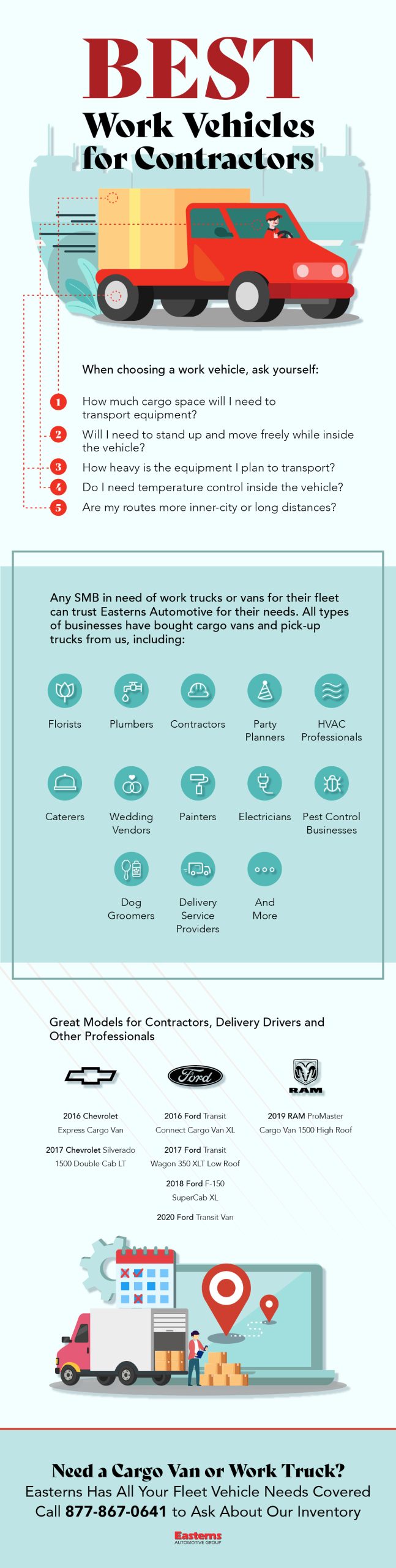
A few questions to ask yourself when choosing a work vehicle:

  1. How much cargo space will I need to transport equipment/tools/goods?
  2. Will I need to stand up and move freely while inside the vehicle?
  3. Are the equipment/goods I plan to transport extremely heavy?
  4. Do I need to store my product in a temperature-controlled environment?
  5. Are my routes typically more inner city or long distances?

Examples of Work Trucks and Cargo Vans for Specific Industries

Work Vehicles for Electricians

Electricians need an efficient work van or truck with the proper storage to organize tools and power their operations. There are a few options for this line of work designed to support an electrical contractor’s day-to-day work.

  • Pick-up trucks – One of the most fuel-efficient options and great for long drives and residential jobs. Pick-up trucks with roomy cabs offer the most comfortable option for transporting several crew members between job sites, and you can add a towing trailer for more storage.
    • Example models include Ford’s F-series like the F-150 or Chevrolet Silverado
  • Cargo vans – Perfect for smaller jobs in multiple locations. Cargo vans allow for ample storage and a safe place to lock tools and equipment.
    • Example models include Ford’s Transit Vans (i.e., 2019 Ford Transit) or the Transit 250 Medium Roof
  • Service utility vans – Ideal for commercial jobs and hauling a lot of materials. Service utility vans can be customized for internal and external storage, providing a lot of space for organization and accessories.
    • Example models include the Ford Transit Cutaway Chassis or Reading’s or Knapheide’s service utility vans

Work Vehicles for Pest Control

Aside from storage space, exterminators need a reliable and fuel-efficient vehicle. Traveling to many job sites throughout the day makes efficiency and reliability important aspects of any vehicle they drive.

  • Cargo vans – Extremely cost-effective in terms of fuel and space management. Cargo vans offer plenty of room for adding storage bins and built-in shelving.
    • Example models include Ford’s Transit Vans
  • Cutaway vans – Ideal for high-level technicians who need to haul more equipment than the average cargo van can hold. Cutaway vans function as a mobile workshop and maximize storage space to help you cut down on travel costs and vehicle downtime. 
    • Example models include the Chevrolet Express Cutaway
  • Service utility vans – Cuts down on the amount of time spent looking for tools and materials. Service utility vans are efficient and highly functional with options for customization and organization. Some feature an easy one-button lock system to secure all doors and latches.

Work Vehicles for Plumbers

While plumbers could use any type of vehicle to get around from job to job, there are work vehicles specifically designed for plumbing contractors. These vehicles provide features like internet modems, overhead conduit storage and straight walls for easy shelving and organization.

  • Cargo vans – Depending on the make and model, cargo vans can come equipped with high-end features such as 4G modems for on-the-go business management. Reputable cargo van models are also known to be extremely reliable and low maintenance. Some even have room for a ladder rack to secure ladders and pipes without compromising cargo space.
    • Example models include the RAM ProMaster or Ford’s Transit Vans
  • Box trucks – Budget-friendly option that won’t break the bank. Not only are they built for weight and space, but they have the potential to be transformed into a mobile workspace. Cargo is secure with only one access point.
  • Service utility vans – Designed to store a wide variety of tools and equipment and easily organize materials from pumps to ladders. The external compartments make it easy to grab what you need without having to open the whole van. Extra space may be ideal for bulky equipment like sewer line inspection and replacement gear.

You’ll find a lot of feature similarities when comparing different makes and models of work vans and trucks. Scheduling test drives and in-person inspections is the best way to decide which is right for you. While shopping used is a great way to save money on a high-quality truck, you should pay careful attention to the condition of pre-owned commercial vehicles before purchasing.

Local businesses in the Washington D.C. and Baltimore areas have relied on Easterns Automotive for the last 30 years. Give Easterns a call at 877-867-0641 or visit one of our eight dealerships for more information on the work vehicles we have in stock.

Best Work Vehicle for Contractors

What Should You Look for in a Cargo Van for Your Small Business?

Cargo vans are a necessity for many businesses that need to transport goods or haul equipment between job sites. From catering to contracting companies, cargo vans are an excellent way to get from one job to the next with all your product and equipment securely stored and organized.

How do you know which cargo van is right for your business? It comes down to efficiency, features and personal preference. When inspecting various options, ask yourself the question, “Will this van work for me and help me serve my customers well?”

What Businesses Need Cargo Vans?

Easterns Automotive has been selling vehicles to businesses and commuters in Virginia and Maryland for more than 30 years. We’ve helped all types of businesses find great work trucks and cargo vans to meet their needs over the years, including:  

  • Florists
  • Plumbers
  • Contractors
  • Party planners
  • HVAC professionals
  • Caterers
  • Wedding vendors
  • Painters
  • Electricians
  • Pest Control
  • Dog groomers
  • Delivery services
  • Production companies

Key Features of a Cargo Van

Gross vehicle weight rating (GVWR) – The maximum weight of a cargo van. For example, if a cargo van’s GVWR is 8,000 pounds and it weighs 4,000 pounds empty, then you have 4,000 pounds left to use for loading.

Payload capacity – The payload capacity is how much weight you can add to the vehicle. (i.e., the 4,000 pounds you have left to load.)

Fuel type – Will the van require gas or diesel, and does that matter to you?

Roof height – If you plan on being able to stand inside the cargo van, make sure to find a van with a roof height tall enough to walk around in.

Cargo space – Obviously, you’re purchasing a cargo van for the space in the back. Make sure you consider everything that needs to fit back there and how it would need to be organized in order to meet your needs.

Drivetrain – There are four types of drivetrains: all-wheel drive (AWD), four-wheel drive (4WD), front-wheel drive (FWD) and rear-wheel drive (RWD). Think about what type of terrain and climate you’ll be driving in and determine what will be the safest, most efficient drivetrain for your cargo van.

Safety features — Newer cargo vans have many of the same safety features we see in commuter vehicles nowadays. (i.e., blind-spot monitoring, lane-keep assist, automatic headlights, etc.) These features can help prevent accidents, shielding your business from potentially costly liability claims.

Wheelbase – The general rule of thumb is the longer the wheelbase the smoother the van will drive, and the shorter the wheelbase the bumpier the ride. Shorter wheelbases have more maneuverability, allowing for easier and tighter turns, while longer wheelbases provide a more comfortable, stable ride (this is especially important for passenger vans).

Doors – Cargo vans have several potential door variations. Dual-side doors are fairly self-explanatory; there are doors on both sides of the van. Dutch doors are doors on the back of a van that are hinged to swing out to the side. Some vans even have a rear lift gate like a commuter SUV or minivan. From a business perspective, rear lift gates tend to be the least functional option. Most businesses will want either Dutch doors or dual-side doors.

Powertrain – Commercial vehicles like cargo vans offer more powertrain and fuel options than many commuter vehicle models. Newer models of Ford, like the Transit Connect Cargo Van, have many configuration options and emissions-control features, including things like Eco Mode and CNG/propane packages.

Perks of Driving a Cargo Van

  • Fuel efficiency
  • Reliability
  • Interior and exterior customization and business branding
  • Comfort
  • Temperate control (perfect for florists or caterers)
  • Mobility
  • Tax benefits/deductions

For the last 30 years, local businesses in the Washington D.C. and Baltimore areas have relied on Easterns Automotive for their company vehicle needs.

When you’re ready to purchase a cargo van, we are here to help. Give Easterns a call at 877-867-0641 or visit one of our eight dealerships today.

How Did Hyundai and Kia Rebuild Their Reputations?

Hyundai Motor America had a good 2021. Riding the wave of the post-pandemic surge in car sales, the Korean-based auto manufacturer enjoyed a 19 percent year-over-year increase of American auto sales. Out of 738,081 Hyundai vehicles sold in 2021, Americans showed a preference for the Tucson, Elantra and Santa Fe, which were the top-selling Hyundai models of that year.

Hyundai’s present-day popularity comes after years of striving to redefine their own brand. No longer saddled with a collective image of cheap unreliability, Hyundai has made its mark in today’s competitive and versatile auto market.

Hyundai’s Difficult Beginnings

Although the carmaker has been around since 1967, Hyundai didn’t make its American debut until 1986 when it launched the Excel. Unfortunately, the subcompact car didn’t excel at much other than affordability. It had a reputation for lacking quality and reliability.

In 1991, Hyundai reluctantly recalled almost 900,000 Excel models based on faulty engine parts that could have led to a fire. Drivers also reported stalling and other drivability issues. After the Excel fiasco, Hyundai’s auto sales and image continued to plunge until 1988 when the manufacturer acquired Kia, beginning their redemptive journey toward success.

To stay afloat while figuring out a new and improved strategy, Hyundai refocused their efforts on manufacturing high-quality vehicles. In the late 1990s, Hyundai and Kia introduced a generous 10-year/100,000-mile powertrain warranty, which covered issues with a vehicle’s engine and transmission. Consequently, auto sales and consumer attitudes shifted upward, allowing Hyundai plenty of time to make long-term improvements to its vehicles.  

Nowadays, Hyundai produces a wide range of Hyundai and Kia vehicles—from sedans and hatchbacks to crossover SUVs and pickup trucks, catering to almost every demographic. Regardless of which make and model you choose as your next vehicle, you can rest assured it’ll embody a balanced mix of affordability, style and practicality.

Why Choose Hyundai

Apart from the versatility in models and designs, there are several other benefits to driving a vehicle manufactured by Hyundai. These benefits include:

  • The best warranty standard on the market, including a 10-year/100k-mile powertrain warranty and 8-year/80k-mile federal emission defect and performance warranty on new cars.
  • Hyundai has gained a reputation as one of the safest vehicles to drive according to the Insurance Institute for Highway Safety. The top models to get near-perfect scores are the Palisade, the Sonata and the Kia Forte.
  • Hyundai is passionate about philanthropy and bettering the community. The Hyundai Hope on Wheels organization has donated over 200 million dollars to pediatric cancer research since 1998.
  • If you’re interested in driving an alternative-fuel vehicle, Hyundai offers several hybrid and electric versions of their top-selling models, including the Kona, the Tucson and the Elantra.

Most Popular Hyundai and Kia Models in the U.S.

Hyundai Tucson

The Tucson is a compact crossover SUV that has been around since 2004. It’s considered one of the most reliable SUVs and is currently the top-selling Hyundai SUV model.

Hyundai Sonata

The Sonata is a mid-size car known for its fuel efficiency, elegant interior design and smooth riding experience. The Sonata has been manufactured since 1985 and has undergone several improvements in performance and reliability over the decades.

Hyundai Palisade

The Palisade is one of the youngest members in the Hyundai family. This mid-size crossover SUV made its first appearance in 2018 but already earns high ratings for engine power, comfort and abundant cargo room.

Kia Forte

The compact Kia Forte is an excellent option for drivers looking for a reliable, no-frills vehicle. Despite its small size, the Forte boasts a large trunk and spacious cabin. It offers excellent fuel-economy for an affordable price.

Kia Soul 

Known for its unconventional boxy exterior, the Kia Soul offers much more than just a quirky look. The Soul is a subcompact SUV that boasts plenty of cargo room, affordability and great safety features, like blind-spot monitoring and collision-avoidance assistance.

Kia Optima

The Kia Optima is a mid-size car offering an abundance of benefits, including an excellent safety score, smooth ride, large trunk and rich infotainment system.

Explore Affordable Pre-Owned Hyundai and Kia Models at Easterns Automotive

Are you in Maryland, Virginia or the DMV and looking for a reliable and affordable vehicle? Consider getting your next car from Easterns Automotive. We offer a diverse inventory of pre-owned Hyundai and Kia models, as well as a variety of other makes and models to meet your unique needs.

We’ll never sell you a vehicle unless it’s passed our rigorous safety inspection. When you purchase from Easterns Automotive, you can rest easy knowing your vehicle is certified, reasonably priced and ready to serve you and your family for years to come.

To inquire about our inventory or schedule a test drive of a pre-owned vehicles, call (877) 867-0641 or visit one of our dealerships.

Is There a Right Way to Negotiate Used Car Prices?

The art of haggling isn’t something most Americans are particularly keen on. While many countries consider relentless bargaining fair game, American consumers and traditional retail businesses are accustomed to clear pricing expectations.

However, there are exceptions, especially on expensive pre-owned products with variable quality, like used cars. If you’ve ever purchased a pre-owned car, chances are good you were able to work out a more favorable deal than the vehicle’s original price.

Some people like to purchase brand-new cars for their perceived reliability (generous warranties, no murky history or damage from accidents, etc.). However, today’s post-pandemic auto market has priced many auto shoppers out of the new car market.

Stalls in auto production during the COVID-19 pandemic and continuing supply chain struggles and parts shortages have caused a national shortage of many new vehicles. As a result, many drivers are switching gears and choosing to purchase pre-owned vehicles instead.

Shoppers looking for a great deal on a used car may benefit from doing plenty of research on their favorite makes and models and brushing up on their negotiation skills before setting foot in a dealership.

How to Negotiate a Better Price on a Pre-Owned Car

There is no blueprint to a successful car price negotiation. However, there are many things you can do before and during your visit to a dealership or when meeting with a private seller to maximize your chances of getting a good deal on a car that’s caught your eye.

Decide What Make and Model You Want

If you’re looking for a used car, take some time to establish what you’re looking for. Perhaps you already have a specific make and model in mind. If that’s not the case, ask yourself what you need in your next vehicle and how much you can afford to spend. Then, based on your determinations, look for vehicles that match your preferences. Some things to consider include:

  • The size
  • Fuel efficiency
  • Safety and reliability
  • Whether the vehicle will fit in your garage
  • What you like and dislike about your current vehicle
  • How you’ll use your new vehicle (commuter car, road trips, off roading, etc.)

Research Prices

Once you’ve decided on a vehicle, learn how much it’s worth. You can do this by going online and researching various dealership inventories and online used car retailers. Also, if you’re going to trade in your current vehicle, make sure to know how much it’s worth to get a fair offer.

DirectCarBuying.com, powered by Easterns Automotive Group, makes it easy for Washington DC and Baltimore car shoppers to maximize their current vehicle’s trade in value.

Avoid Becoming Car Poor

Unless you pay cash, you likely will need to take out a loan to finance your used car purchase. A monthly auto payment can put a significant strain on your finances. Make sure you know the limits of what you can afford when you start shopping.

Back Up Your Counteroffer with Facts

Negotiating a better price can only be successful if you can back up your counteroffer with facts. Get quotes for similar makes and models from other dealerships and use them as leverage in your negotiations.

Print any instant cash offer you may have gotten for your trade-in vehicle. If the dealership you’re interested in buying from tries to lowball you, you can show them tangible proof your current vehicle is worth more than what they’re offering.

Effective Communication Can Go a Long Way

Successful negotiations require effective communication. Here are some communication tips to help you get the upper hand while bargaining for your preferred used vehicle:

  • Always remain courteous and respectful. Trying to play “tough” or using intimidation will discourage any salesperson from working with you.
  • Negotiate thoughtfully. Write things down, ask questions and ask for clarification if something isn’t clear to you.
  • Keep the conversation light and even humorous but remain calm, matter of fact and firm in your convictions.
  • Know when to walk. Not every private seller or dealership is willing to negotiate prices on their used inventory. If you feel you’re getting nowhere in your negotiating, don’t be afraid to walk away and continue your search elsewhere.

Visit Easterns Automotive for a Pressure-Free Used Car Shopping Experience in DC, Maryland and Virginia

When you shop at Easterns, you won’t have to worry about haggling over a price. We make our vehicle prices as competitive and transparent as possible. If you’re looking for a certified and reasonably priced used car, be sure to browse our plentiful pre-owned inventory.

For more information or to schedule a test drive, call (888) 650-4775 or visit one of our dealership locations.

Do Electric Cars Need Oil to Run?

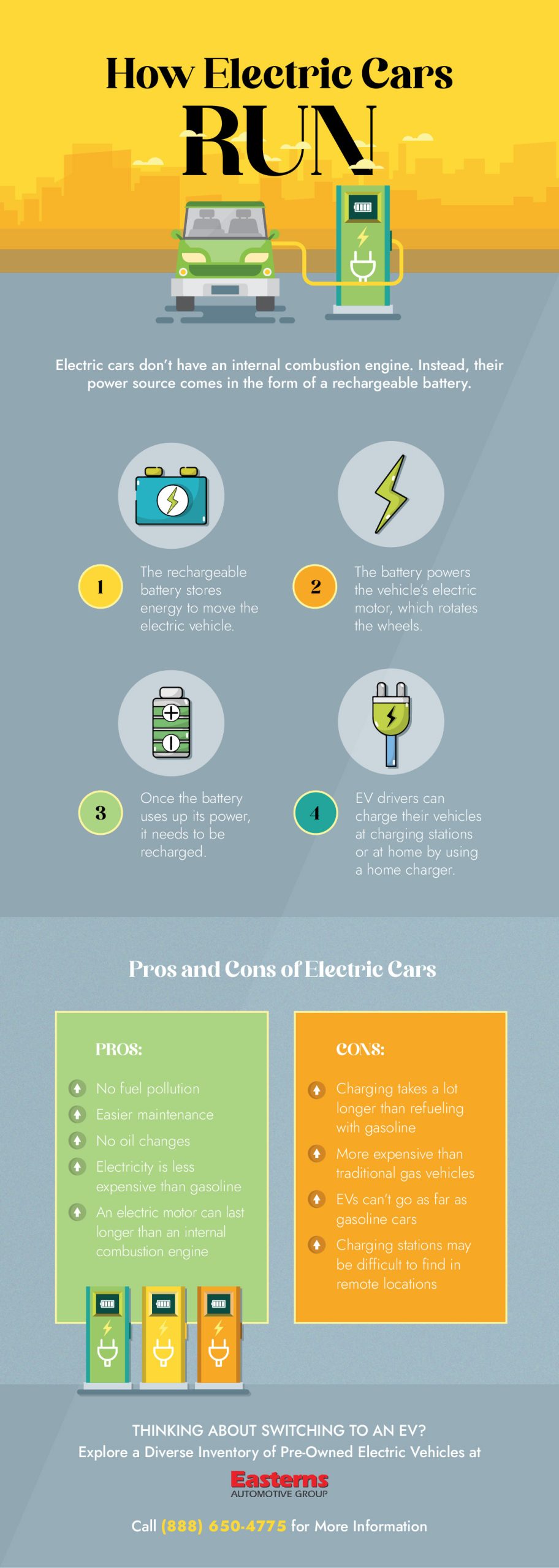
Electric cars, also known as electric vehicles or EVs, do not need oil to run. Owning an electric vehicle means you’ll never have to worry about scheduling oil changes the way you would for a traditional gasoline car with an internal combustion engine.

However, this doesn’t mean your electric car won’t need any maintenance at all. Are you thinking about buying an electric vehicle? Make sure you know the maintenance needs and costs that come along with owning one before you make your purchase.

Why Is Oil Not Required in Electric Cars?

A typical gasoline car relies on an internal combustion engine to run. The engine’s job is to convert gasoline and air into motion via pistons and a crankshaft, which is how you’re able to drive your car. A combustion engine is a complex machine and consists of intricate pieces. For these pieces to glide smoothly, the engine must be lubricated with oil. Regular oil changes ensure your car’s engine remains in good condition.

Since electric cars don’t use gas, they don’t need internal combustion engines to run. Electric cars rely on an electric motor and rechargeable batteries to move, which frees you from the necessity of regular oil changes.

How Does an Electric Car Work?

An electric car is powered by an electric motor which converts electrical currents into motion via a central rotor and a rotating magnetic field. Your EV uses energy stored in its rechargeable battery to power the motor.

People typically charge their EV batteries at public charging stations or at home by plugging a charging unit into a wall socket. EVs are quiet to drive and move along streets, roads and freeways without producing environmentally harmful emissions.

What Kind of Maintenance Does an Electric Car Require?

While EVs don’t need oil changes, there are several parts that will need regular maintenance.

Coolant

Your electric car’s battery produces heat while generating power. This means your vehicle needs a coolant to protect it from overheating. Make sure to keep the coolant levels for your battery consistently high to prevent overheating.

Cabin Air Filter

While your EV doesn’t produce gas emissions, you’ll still need to replace the cabin air filter to keep the air inside your car clean. Ideally, your cabin air filter should be replaced every 15,000 to 30,000 miles.

Battery System Replacement

Your electric car’s battery system has limited efficiency, which means you may need to replace it with a brand-new battery pack at some point in your EV’s lifetime.

Luckily, EV batteries are estimated to last between 10 to 20 years, giving you the option to get another vehicle before the current battery system no longer holds an adequate charge.

Other Fluids

Apart from battery coolant, your electric vehicle needs brake fluid and windshield washer fluid. Your mechanic can check your brake fluid during routine maintenance and let you know if it needs to be replaced. Typically, brake fluid in an electric vehicle should be replaced every two years or 30,000 miles, whichever comes first.

You should refill your windshield fluid every few months. Topping it off regularly will keep you from running out when your windshield is dirty or covered in ice.

Maintenance That’s Not Required

Your electric vehicle doesn’t have the following items; thus, you’ll never have to worry about replacing or fixing them:

  • Spark plugs
  • Air filter
  • Fuel filter
  • Muffler
  • Catalytic converter
  • PCV valves
  • Exhaust gas recirculation system (EGR)

Explore Pre-Owned Electric and Hybrid Vehicles at Easterns Automotive in DC, Maryland and Virginia

If you’re looking to purchase an electric or hybrid car, but a brand-new vehicle is outside your price range, Easterns Automotive can help.

We have an attractive inventory of used EV and hybrid vehicles to meet your needs. Each car we sell undergoes a rigorous inspection to ensure safety and quality.

Prefer a traditional gasoline car? Check out our full pre-owned inventory featuring hundreds of amazing cars, trucks, vans and SUVs.

Find your perfect pre-owned car by calling (888) 650-4775 or visiting one of our dealership locations.