Category Archives: FAQs

What to Do When the Check Engine Light Comes On

You never want to ignore a check engine light. It’s important to take steps to figure out what the malfunction may be.

Check engine lights vary depending on the manufacturer. They are usually red, orange or yellow and typically appear as a car engine symbol. The check engine light is commonly confused with the “service light.” However, the “service light” doesn’t indicate a mechanical problem and usually means the vehicle is due for regular service.

The sensors in the engine monitor the operation of the vehicle’s systems. These sensors connect to the On-Board Diagnostic II System (OBD II.) When a system isn’t functioning correctly, the check engine light will alert you.

The two types of check engine warnings are:

  • Check engine light is flashing: This indicates a more severe problem. If the vehicle is running when a flashing check engine light comes on, pull over to a safe location and shut the engine off. To prevent further damage, you may want to have the car towed to a service location.
  • Check engine light is solid: If the check engine light appears and remains on, you should get your vehicle assessed as soon as possible. A variety of issues could be responsible–all of which you will want to get sorted out as quickly as possible.

How To Fix the Check Engine Light

Every problem that may cause the check engine light to come on has a corresponding code in your car’s computer system. This information is logged by the engine’s sensors and is read with an OBD II scanner or a reader that is connected through the OBD port located beneath the steering column.

There are three options for reading the code:

  1. Have it read at an auto parts store. Most auto parts stores will read the code for free. If the code is for something minor, it could be an easy fix that you can handle yourself.
  2. Read the code yourself. You will have to buy a scanner for this option. The costs for these scanners vary considerably depending on the device’s complexity and the age of the vehicles on which they work.
  3. Have the mechanic perform diagnostics. There is usually a fee for this service. However, some repair shops may waive the cost if you agree to have the necessary repairs performed at their shop. Consider calling ahead to determine initial costs.

Although there are still some mechanically minded drivers who like diagnosing and repairing their own vehicles, these people are in the minority. If your check engine light goes on, you’ll likely want to head to your preferred mechanic.

Should I Reset the Check Engine Light?

In some cases, it is possible to reset the check engine light. Using a code reader, you may be able to turn the light off yourself. However, this isn’t recommended. If there is a problem, resetting the check engine light won’t help fix it. Ignoring an engine problem can lead to it worsening or more issues arising.

Causes for the check engine light can vary and the cost of fixing the problem may be low or extremely high depending on the severity of the issues. What could start as a simple spark plug issue could lead to a serious problem with a more expensive system, such as the catalytic converter. Your best option will be to determine the cause of the code then seek professional help if the issue is a complicated one.

What if the Check Engine Light Is for a Costly Repair?

Perhaps the time has come to upgrade your vehicle. Easterns Automotive can simplify your car selling and buying process. We make trading in your car to one of our dealerships in the Washington, DC and Baltimore metro areas fast and easy. Give Easterns a call at 877-867-0641 or visit one of our dealerships today for more information.
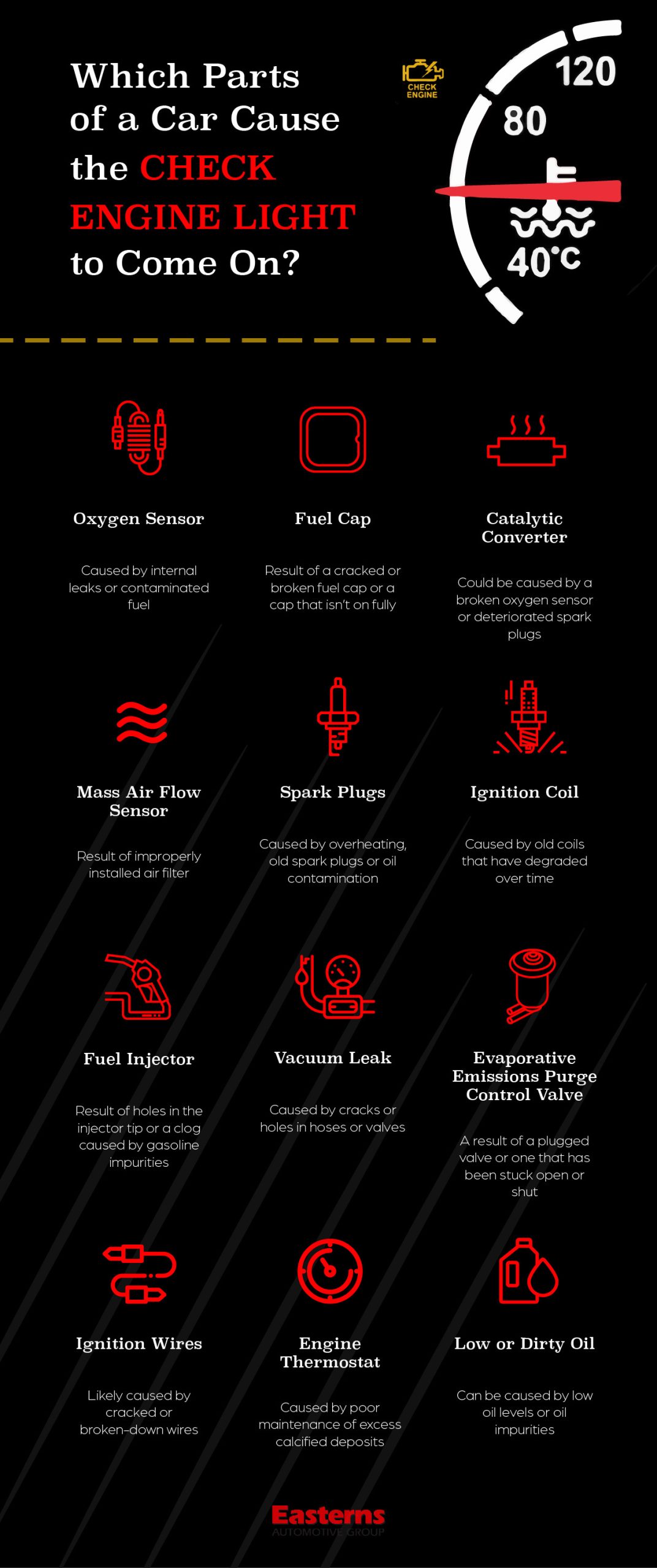
what car parts are associted with check engine lights

DOWNLOAD PDF

Why Are Used Cars So Expensive Right Now?

The average price of used cars has risen every month for the last few years. A slow, steady rise in pre-owned prices began around 2016. Then, it seemed to compound in 2020. The increase stems from a combination of pandemic-related market fluctuations and the supply and demand of parts for vehicle manufacturing.

Supply Chain Shortages

When the pandemic hit, supply chain shortages and workplace restrictions forced auto manufacturers to produce fewer new cars. This increased the cost and discouraged buyers from opting for newer vehicles. These factors, combined with higher unemployment and financial hardship, resulted in consumers gravitating toward used vehicles rather than new cars, truck and SUVs.

Many have opted to hang on to their older vehicle until used car prices go down, leading to fewer used cars being available for sale. This constrained supply of both new and used vehicles has led to higher prices on used cars for sale.

When COVID-19 hit, chip suppliers were forced to shut down their factories to protect the health of their employees. Once production resumed, the factories were overwhelmed by insurmountable chip orders from every industry and sector that uses chips in manufacturing. Automobile manufacturers are just one of many who have since been forced to cope with inadequate chip supplies. The chip shortage has pushed up prices for new cars, which further discouraged new car purchases, leading to an increase in the demand for and price of used vehicles.

Luckily, the effects of the pandemic appear to be temporary. As our lives return to normal, chip suppliers have begun to catch up with pent-up pandemic demand and supply chain conditions are improving across the board.

New Cars Are Also More Expensive  

Advancing technology has also led to a rise in new car costs. Cars continue to get larger, increasing the amount of material used to make them. A fully loaded new vehicle is bound to cost more due to its higher-strength steel frame and fancier electrical systems.

Along with higher material costs, many countries have also opted to increase their vehicle emission standards. This has caused manufacturers to invest millions in research and development to follow and comply with changing regulations. The cost of new green technologies is ultimately borne by vehicle purchasers in the form of increased prices. This leads to a rise in the price of used cars as well.  

When Is the Best Time to Buy a Used Car?

There is no “better” time to purchase a pre-owned vehicle. Whether you are trading in a vehicle, seeking financing, or looking to buy outright, purchasing or leasing a used car has never been easier!

When you buy from Easterns Automotive Group, you can expect an uncomplicated and stress-free buying process. We have an impressive used vehicle inventory that offers a wide selection of car options. Those benefits, along with our fair pricing and flexible financing options, means anytime is a good time to purchase a used vehicle from Easterns Automotive Group.

How Can Easterns Help with Rising Costs?

Price fluctuations in the auto industry don’t mean it is impossible to find a decently priced and reliable vehicle. All our inventory undergoes rigorous multi-point certification checks. This means you can buy with confidence knowing that you are purchasing a safe and dependable used car that shouldn’t require expensive repairs that make owning a pre-owned car more expensive.

At Easterns Automotive, we are proud to work with more than 30 lenders to increase the chance we can find a great auto loan for every car buyer, even those without perfect credit. This allows us to give our clients better options on rates and terms. 

Plus, your car buying process is entirely customizable. You can shop online, in person or both. Our professional and experienced staff will guide you through the entire car-buying process.

If you are in the market for a certified pre-owned vehicle, we invite you to visit an Easterns lot in Baltimore or Washington, DC, or call today at 877-867-0641. Experience firsthand what we mean by the Easterns difference!

Can I Get an Auto Loan if I’m Going Through Chapter 7 or Chapter 13 Bankruptcy?

Yes, it is possible! Guidance is key, and Easterns Automotive is here to help. If you are a Virginia or Maryland resident that has recently filed for bankruptcy, it is important to know that you have auto loan options. You may be able to purchase a newer car with a lower payment before your bankruptcy discharge. Plus, you will have the opportunity to add a factory or extended warranty that may help you avoid unforeseen repair expenses that could derail your budget.

The best way to financially recover from bankruptcy is to rebuild good credit. This can be difficult if you can’t find a lender to approve you for loans. At Easterns Automotive, we’re committed to helping Washington, DC and Baltimore residents get the vehicles they need even during or after bankruptcy.

How Do I Get a Car Loan When Filing for A Bankruptcy?

Many bankruptcy car buyers find it beneficial to get a new auto loan prior to discharge instead of reaffirming their existing car loan. Bankruptcy laws allow you to walk away from your current loan and replace it with a newer one, which is why you should initiate your new car loan sooner rather than later.

You may be thinking that there are no lenders that will approve you for financing after filing for bankruptcy. This isn’t the case! At Easterns Automotive, we work with dozens of lenders to increase the chance we can find a great auto loan for car buyers who have credit problems. Working with this many lenders, allows us to give our car shopping customers options on rates and terms. You may find you qualify for more auto loans than you realize!

When working with our team at Easterns, bankruptcy filers will have the opportunity to participate in our Fresh Start Vehicle Loan Program. Some of the features of this special bankruptcy auto loan program include:

  • Financing for up to $40,000
  • Requires little to no money down
  • Available to people with open or recently discharged bankruptcies
  • Eliminate negative equity and allows you to re-establish your credit
  • No minimum credit score required
  • A true fresh start!

What Does “Your Job Is Your Credit” Mean?

Credit problems happen for all kinds of reasons, and we understand that going through bankruptcy or having less-than-perfect credit doesn’t mean you aren’t a responsible person. That’s why we look at other factors, including your job history, when determining your loan eligibility.

Will Getting a Car Loan Hurt or Help My Credit Score After Bankruptcy?

Qualifying for an auto loan will affect you in two primary ways. Lenders will perform what are known as “hard inquiries” with the three credit bureaus to check your credit risk and determine your loan eligibility. A single hard inquiry won’t have much effect on your credit score, but multiple hard inquiries in fast succession can have a negative impact on your credit score.  

Any damage done by a hard inquiry is more than made up for by the benefits of making payments on time. The best way to build your credit score is qualifying for financing and then making payment on time and in full.

If you want to begin rebuilding your credit score after bankruptcy, paying your debts on time is a great way to do it. Unfortunately, this path to credit repair is difficult when no lenders will give you credit due to your bankruptcy. At Easterns Automotive, we pledge to look past your bankruptcy and find a workable lending solution for your situation.

We Can Help You Get a Car Loan After Filing for or Discharging Bankruptcy

At Easterns Automotive, the Baltimore and Washington, DC dealership where your job is your credit, you can expect to get friendly, low-pressure assistance with your auto loan and car purchase. Call us at 877-867-0641 or visit a location near you to learn more.

Will Fancy Tech Make New Cars More Expensive and Difficult to Repair?

In some ways yes – fancy gadgets require more specialized parts and training to fix. In the not-so-distant past vehicles were primarily analog in nature. The dashboard dials had more in common with clockwork than computers. That’s all changed in the past decade, and although the advanced sensors and diagnostic suites have made cars safer, they’ve also made them a little more complicated to maintain and repair.

Maybe the most obvious example are Tesla vehicles. They’ve essentially done away with anything that could potentially be considered analog. Nearly every feature in a Tesla vehicle is controlled through digital displays and computerized tech. Most mechanics can’t work on Tesla vehicles – and according to Tesla that shouldn’t be an issue. They’ve essentially tried to design a car that almost never needs major service. Whether that’s how things turn out remains to be seen.

When it comes to vehicle design, the intended goal and reality often don’t align perfectly. Although many Tesla models do have a reputation for reliability, things can still go wrong. That’s one of the reasons why Tesla founded the Tesla START program.

Tesla – as well as many other auto manufacturers that are releasing ever-more-advanced vehicles – recommend visiting the manufacturer’s service centers for repairs. Service centers can have long wait times, especially when every vehicle owner in a metro area only has one or two options to choose from.

Not every Tesla owner will be near a Tesla service center when something goes wrong, which is why they may need a mechanic elsewhere who understands how to diagnose and repair their vehicle. The Tesla START trade school program is intended to help fill that void.

Another example of this shift in auto servicing education is the GM ASEP program. As we wrote about last month, General Motors is aggressively pursuing electric vehicle technology. The mechanics and vehicle techs trained to work on GM commuter and fleet vehicles today and in the not-so-distant future will need to have a thorough understanding of the diagnostic tools and technologies necessary for repairs and service.

Many Auto Shops Aren’t at a Complete Loss

Computers in vehicles aren’t new. Varying degrees of computerization in cars, trucks and SUVs has been occurring for multiple decades now. Most reputable auto shops have the experience and tools necessary to diagnose problems, update vehicle firmware, reflash software and troubleshoot problems with various engine or transmission controls.

Auto Training Changes with the Times

Organizations dedicated to enforcing quality standards in certain industries aren’t static. The National Institute for Automotive Excellence (ASE) regularly adjusts its various certification testing to ensure up-and-coming mechanics get a relevant education.

Their survival as an organization depends on their reputation for testing new mechanics on the skills auto service centers and repair shops need for modern vehicles. If students started realizing ASE certification wouldn’t help their job prospects, they’d stop paying for trade programs that tailor training to ASE certifications.

Should I Avoid Buying New Cars With Fancy Computer-Driven Components?

One could argue that given the current shortages, having repair needs on a new vehicle could be troublesome. However, there’s also an assumption that new vehicles won’t require big repairs or part replacements right away. If components are recalled or under warranty, you generally won’t have to worry about paying out of pocket for expensive repairs, but you still might have to wait for the job to be done.

In theory, not every mechanic will have the skills or technology to repair every vehicle, especially newer ones. You can still likely get repairs fairly easily, especially if you live in or near major metro areas with a lot of service shops and stations.

If you have your heart set on a newish vehicle, partially because of its fancy tech, you likely shouldn’t let fear of being unable to find an experienced mechanic stop you from getting the vehicle you want.

Get a Great Vehicle With Lots of Gadgets From Easterns Automotive

As a pre-owned dealership, Easterns Automotive sells a lot of great vehicles from the past decade, but we also sell a lot of recent year makes and models, many of which have very few miles. Many of these relatively new vehicles are maker certified and protected by great warranties. They likely feature all the electronic bells and whistles you could want and more.

Browse our inventory to find a great vehicle for your needs or visit one of our eight locations in Washington D.C., Baltimore, Maryland and Virginia. 

How to Spot if a Used Car Is a Lemon

Purchasing a car can be a nerve-racking experience. If your budget is limited, or you want to avoid the rapid depreciation of a new vehicle, you might consider looking into used cars. One of the few potential downsides of purchasing a pre-owned vehicle is getting one that turns out to be unreliable and in need of expensive repairs – or a lemon.

Fortunately, there are plenty of signs that can indicate the car you’ve been eyeing is a lemon.

To help you with your vehicle shopping experience, we have complied a list of the most common lemon signs to look out for.

  1. Vaguely Written Ad
  2. Mismatch Paint Work
  3. Misconfigured Body Parts
  4. Mismatched or Worn-Out Tires
  5. Suspicious Interior
  6. Faulty Suspension System
  7. Manipulated Odometer

Vaguely Written Ad

Ads are supposed to paint the most glowing possible image of a product or service to increase the chance someone will buy it. A car ad doesn’t have to be immaculate, but it should sound professional and contain as much information about the car as possible.

The ad should highlight the car’s best features but also disclose any problems that it has, such as damage or if it’s been in an accident. It’s usually a good sign if the seller explains the reason behind selling the car. An ad that is vague or focuses only on the car’s highlights could be a sign the vehicle has some underlying issues, and the offer is not as good as it sounds.

Mismatched Paint Work

If you walk around the vehicle and notice spots that are slightly different in color, appear faded or are freshly painted, this might mean the car was in an accident and the owner tried to cut corners instead of fully fixing it. Any car with hidden accident damage is best avoided. Plus, fixing mismatched paintwork can get expensive so unless you want to incur additional costs, you are better off continuing your search.

Misconfigured Body Parts

When inspecting a used car, be mindful of any misaligned parts, including irregularities in the alignment of body panels, car doors, hood gaps and trunks. While many sellers will try to downplay these issues and pass them off as minor and harmless aesthetic deficiencies, this might be far from true.

Misconfigured body parts are a major red flag and indicate that the car was most likely involved in a major accident.

Mismatched or Worn-Out Tires

Tires are the proverbial windows into a car’s soul. You can gather a lot of information about the condition of a used car just by looking at its tires. The first thing you should check is if the tires are uniform. In other words, if all four tires are the same size and brand. Uniform tires ensure optimum stability and control of the car.

Moreover, worn-out tires could indicate heavy wear on the vehicle and poor maintenance. Also, if you notice cupped tires, this usually means problems with brakes, suspension or steering.

Suspicious Interior

Just like exterior features, the car’s interior can also give you many clues about the condition it is in.

If you spot any discolorations and stains inside the car, it might indicate that it was flooded in the past. Conversely, if you notice an interior that has brand-new upholstery, it can also indicate that the seller is attempting to cover up water damage.

Faulty Suspension System

When you take a used car for a test drive and notice things like difficulty steering, continued bounding after hitting bumps or drifting when turning corners, these may be signs of serious suspension problems.

You can check the car’s suspension by pushing down on the fenders and then letting go quickly. The car should rebound softly once or twice. If it rebounds more than twice, the suspension probably needs some major repairs, which the seller might not be willing to pay for.

Manipulated Odometer

A used car with relatively low mileage can be a great deal. A car that is low in miles means that it hasn’t been driven much and has plenty of life left in it.

Be warry of sellers who purposely tamper with a car’s odometer. Unscrupulous resellers might go to great lengths to manipulate the numbers so that the car shows low mileage.

If the car is older and displays a lot of wear and tear, but the miles don’t match the appearance, save yourself the headache and look for a different seller.

Do Lemon Laws Apply to Used Cars in Maryland and Virginia?

Lemon laws vary by state and can be nuanced and convoluted. Even if you believe that the used car you purchased is a lemon, the law might say otherwise. You might have to complete several steps before you can file a formal complaint.

Unfortunately, Lemon Laws in Virginia and Maryland only apply to new vehicles and leased vehicles.

Get a Great Used Vehicle from Easterns Automotive Group

Why put yourself through the stress and hassle of purchasing a used car from a questionable seller? At Eastern Automotive, every vehicle on our lot has passed a rigorous multi-point certification check so you can shop with confidence.

If you’re looking for a quality car and a stress-free experience, call us at (877) 867-0641 or visit one of our dealership locations.

Best Luxury Cars to Buy Used

Used cars are hot-ticket items in the current market, so price-conscious shoppers may be weighing their options when it comes to purchasing a vehicle of any kind. Most people who want the tech-laden opulence of a used luxury vehicle aren’t eager to break the bank for their purchase.

Shopping smart and taking a variety of factors into account when making your decision can help ensure you get the most out of your luxury vehicle purchase without overpaying.

A Previously Owned Luxury Car’s Valuation       

Cars depreciate over time – especially luxury vehicles. If you are buying a new vehicle this process starts as soon as you drive it off the lot. Luxury cars tend to have steep initial depreciation, which is great news for used car buyers.

For example, BMW 7 currently has the steepest depreciation at 72.6 percent in five years. That’s a roughly $74,000 drop. BMW 5 is second at 70.1 percent, or $47,000. That means used vehicle shoppers looking for those vehicles are getting a huge discount on a luxury vehicle that’s only five years old. The Maserati Ghibli and Audi A6 also feature highly on the depreciation list at 69 percent in five years.

In all, eight out of 10 of the highest depreciation vehicles in 2021 are luxury vehicles.

Previously owned vehicle shoppers looking for luxury vehicles still won’t be getting the lowest prices on the lot, but they will likely be getting the highest rate of savings compared to the new vehicle sticker price.

Previous Owner Already Paid Most of the Depreciation

By the time you buy a five-year-old luxury vehicle the bulk of the depreciation cost has been paid by the previous owner or owners. When you buy a 2017 or 2018 luxury vehicle in 2021 you might only pay 70 percent of what the original owner paid for it. That means you will likely end up spending $30,000 to $35,000. Your luxury vehicle might depreciate another 50 percent by the time you go to sell in 2026, so instead of losing $70,000 to depreciation on a luxury vehicle you bought new, you will instead only lose about $15,000 to depreciation.  

A Golden Opportunity

Why let a good opportunity go to waste? Used luxury vehicles, when properly maintained, can still provide drivers with a hundred thousand miles or more. There are several luxury car makers that have a reputation for dependability and longevity, especially brands like Lexus, Mercedes Benz and Porsche.

Spending $20,000 or $30,000 to purchase a well-maintained luxury car often makes drivers feel like they are getting a steal. Plus, if a buyer goes with a used luxury vehicle, they may be buying something that is no longer easily found on the market (or that may be an older version of a popular new model). They may end up enjoying unique and hard-to-find attributes at a third of the price as a new luxury vehicle.

A Car’s History

Many used luxury vehicles come with a maintenance and accident report. You’ll have an idea of what has happened to the vehicle, how well its been maintained and whether you see any warning signs for future car problems.

You also get years of testimonials from previous make and model owners on the internet. If you buy a five-year-old luxury vehicle you aren’t getting any surprises. You can check online and learn about the benefits and drawbacks experienced by people who have owned and driven the same type of car for years.

Get a Great Preowned Luxury Vehicle from Easterns Automotive Group

Car shoppers throughout Virginia and Maryland will find a diverse variety of used luxury vehicles in our inventory. We encourage you to call us at (877) 867-0641 or visit one of our eight dealership locations to find out more about our previously owned cars, trucks and SUVs.

What Is a Low-Maintenance Car?

Every car, truck or SUV in the Washington DC or Baltimore area requires regular servicing to help maximize its longevity and performance, but some vehicles require more frequent visits to a dealership or mechanic than others.

Vehicle maintenance isn’t entirely about mechanical or electrical issues. Things like auto insurance, the cost of fuel and taxes are all added prices you’ll need to pay to continue driving your vehicle. These added costs of vehicle ownerships might also be considered maintenance costs by some.

By that standard, any vehicle that can be well maintained with oil changes and tire rotations but also offers low insurance and registration fees qualifies as low maintenance.

Used Hondas

Consumer Report has a helpful guide for the average maintenance cost of previously owned vehicles that are 5- or 10-years old. The difference in maintenance between certain car makers is striking.

Hondas generally have a reputation for being a reliable brand, and many of their vehicles do make the least expensive to maintain list, including the 2011 Honda CR-V, Fit and Ridgeline. Only the 2011 Honda Odyssey and Pilot made the most expensive to maintain and repair list.

Used Toyotas

Toyota Priuses especially earned a reputation as being one of the more reliable, long-lasting hybrid vehicles. According to Consumer Report they have approximately $260 in repair costs at the 10-year mark. Other low maintenance Toyotas (at the 10-year mark) included Avalon, Camry, Corolla, Tacoma, and Tundra.

Used Chevrolets

If you are in the market for a used Chevrolet, the Silverado 1500 and Tahoe were cited as being low maintenance models at the 10-year mark by Consumer Report. The Chevrolet Suburban and Traverse have on average $590 and $900 respectively in maintenance and repair costs at the 10-year mark.

Used Hyundais

Hyundai Genesis made Consumer Report’s list as being a low-maintenance model at the 10-year mark, with repair and maintenance costs running at approximately $200.

Used Nissans

We could not “leaf” the Nissan Leaf off this list – according to Consumer Reports this vehicle had no maintenance or repair costs associated with it at the 10-year mark.

If you are looking for a pickup truck, then a Nissan Frontier may be the final frontier for you with a low 10-year $200 maintenance and repair price tag attached to it.

Which Vehicles Have the Lowest Insurance Costs?

Your vehicle is just one of many factors that go into the equation that determines your auto insurance premiums. Other factors include your age, gender, the state and city in which you live and drive, your driving record and even your credit. The only factors insurance companies aren’t allowed to consider when determining your insurance costs are race and religion.

The vehicle you choose can have a positive or negative impact on your auto insurance rates. The insurance company will take into account:

  • How frequently the make and model is stolen
  • The vehicle’s engine size
  • The car’s official safety record and rating
  • Whether it is equipped with cutting-edge safety equipment
  • The replacement cost of the vehicle
  • The cost of repairs

There are several important things to keep in mind when purchasing a car that will be relevant to your insurance costs.

  • Used cars cost less to insure since they’ve already depreciated quite a bit by the time you purchase it
  • Older vehicle that don’t have quite as many fancy electronics or gadgets are less expensive to repair which often means lower insurance rates

Many pre-owned vehicles available at Easterns Automotive also come equipped with some of the latest safety features, which may entitle you to an insurance discount.

Get a Great Used Car, Truck or SUV with Low Maintenance Costs in Baltimore or Washington DC

There may be other costs in addition to price associated with the purchase of a previously owned vehicle, so if you are in the market for a used car, truck or SUV in Maryland or Virginia, check out our selection at Easterns Automotive Group. Give us a call at (877) 867-0641 or browse our inventory to find a low-maintenance vehicle that’s right for you.

Three Ways to Get the Most Money for Your Trade-In

If you are considering buying a new car, you might also be looking into trading in your current vehicle. While some vehicle owners believe private sales are better because it will result in a better sale price, trading in a vehicle offers far less hassle and less risk of costly errors. According to Consumer Reports, most people prefer to trade their vehicle in because it is easier than selling it themselves. All the paperwork, signing and financing is done in one place.

If you want to get great value out of your car without the drawn-out process of selling it yourself, it just makes sense to trade in your vehicle. Here are some ways to make the most out of your trade in.

Don’t Trade in Your Car and Shop for a New Car at the Same Time

Trading in your car is a great option for those shopping for a new or even used car, but you want to start with knowing your trade in value before going out to explore your options on a purchase.

Approach the trade in process the same way you would approach buying a new car; get several quotes before making a decision. Going to a dealership and asking for a trade in valuation well before telling them you are interested in purchasing a vehicle will take the focus off the new car purchase and emphasize the value of what you already have. It also allows you to compare estimates with other sources and negotiate with dealerships using those other offers as leverage.

Do Trade in Value Research

Do some research online as if you are looking to buy the exact model that you are trading in. What are they selling for currently? And what are the conditions of those models on the market? Knowing this information can help you compare the trade in estimates you’re receiving.

Gather all the information that you will need to calculate your own trade in vehicle’s value based on the:

  • Make
  • Model
  • Year
  • Mileage

Kelly Blue Book, AutoTrader, and Edmunds provide tools that allow you to calculate the value of your car so that you can compare it with a list of similar vehicles.

This step is crucial in determining what’s a fair offer from dealers and help you negotiate your trade in value. While the trade-in offers you receive wont exactly match the full sale price you estimate, it can help you understand where you stand in a pre-owned purchase. The amount that you trade your vehicle in for is kind of like a discount on the vehicle you eventually purchase.

Does Your Trade-in Vehicle Need a Tune up and a Shine?

If the vehicle needs work done, it will always be valued less. Big ticket items like new brakes, tires or transmission issues can cost you. Even minor inconveniences might have dealers raising eyebrows. If you did not bring the car to them in good condition they might wonder, “What else could be wrong with it?”

This is a concern for dealers when they are determining trade-in valuation. Their goal is to make a profit, and they can do that best when they can resell a traded-in vehicle that has less than 100,000 miles. If your vehicle has over 100,000 miles, they are likely to auction it, in which case you could be getting less for trade in value.

That is why it is also important to bring proof of any servicing and maintenance that you have had done on the vehicle over the years, including things like oil changes and tire rotations. A record of good care will help bolster your trade in’s valuation, regardless of mileage.

Make sure the vehicle looks presentable. Cleanliness helps dealers clearly see the value of the vehicle. Don’t put more money into the vehicle with upgrades; just make sure it is cleaned and vacuumed so it looks its best when you start shopping it around.

Ready to Trade Your Car In?

Take your vehicle into a dealership that you can trust. Easterns Automotive is always looking for trade in vehicles or pre-owned vehicles to buy, and we are happy to help our customers trade, shop and purchase a vehicle their way. We have eight locations serving Washington, DC, Baltimore and the greater Maryland and Virginia areas.

If you are ready to trade your vehicle in, bring it to one of our dealership locations and we will give you the fairest price possible. We wouldn’t be surprised if you also came across the perfect vehicle for your new purchase as well.

If you have questions about the value of your current car, truck or SUV, call us at (888) 650-4775.

Will Electric Vehicles or Traditional Gas Cars Have Better Resale Values?

The transition from gas powered vehicles to electric and hybrid vehicles is sweeping the nation. Although the change is good for environmental sustainability, it’s less clear whether EV or hybrid vehicle purchases are a good financial investment for vehicle owners. There is much debate surrounding whether an electric vehicle is a good purchase in comparison to a traditional gas-powered vehicle, as well as uncertainty surrounding future resale value of EV and hybrid vehicles.

Advancement in Batteries Makes New Electric Battery Models More Affordable

As it stands, current owners of older model electric vehicle are in a sticky situation. As improvements in battery technology in EVs and hybrids are being made, the price of the batteries are dropping. Since batteries in these vehicles make up more than 50 percent of the vehicle’s value, the overall price of electric-powered cars is coming down.

With the advancement of EV batteries in new and future models also comes a drop in resale value in older EV models. The lower quality and life expectancy of batteries in older models of electric vehicles make them harder to sell. In fact, the average resale value of these older EVs and hybrids is less than 40 percent of the original value.

Gas Powered Vehicles Hold Their Value Over Electric and Hybrid Models

In comparison, traditional gas-powered vehicles currently have a better resale value of 50 to 60 percent of their original valuation. Evidently, people still prefer gas-powered vehicles over EV. Some reasons might include concerns over charging stations, convenience, battery life and style.

Another factor affecting EV popularity are changes in consumer preferences. SUVs and trucks have significantly risen in desirability over sedans and cars, and there are still few options for EV and hybrid SUVs and trucks.

Hope for Hybrids and Electric Vehicles

The news is certainly not all bad for electric vehicles. With more companies committing to transitioning entirely to EV models in the not-so-distant future, the used EV market is sure to improve over time. Plus, more hybrid and electric vehicles are being designed to better appeal to current auto shoppers.

There are some battery-powered SUVs coming on the market to compete with the highly sought-after gas-powered models. With the improved battery life, EV Crossover models like the Tesla Model X are expected to keep their resale value.

Tesla is ahead of the game in resale value and depreciation. Other brands like Jaguar, GMC and Volvo are attempting to compete in the EV market in the future with all EV or hybrid models within the next couple decades. Problems and concerns over charging stations and battery life are sure to lessen as technology and infrastructure catches up to the proliferation of EVs.

The government’s added incentivizes like rebates and tax credits for the purchase of electric vehicles and charging equipment could persuade people to switch from gas powered vehicles to electric and hybrid. This uptick in demand may drive up the value of these vehicles.

When Is the Best Time to Sell My Car?

Regardless of whether you have an electric vehicle or a gas-powered car, now is a good time to sell. The prices of preowned vehicles are at historic highs after the pandemic, which is great news for people who want to sell their cars.

According to Edmunds, the shortage is expected to last until 2023. With the scarcity of even EVs and hybrids, you are likely to get a great price for your vehicle. If you are concerned about the value of your EV or hybrid decreasing, now is the time to sell!

Gas-powered vehicles will not be phased out for a long time. As long as the traditional car, truck and SUV industry continues to make a profit, they are going to keep pumping out new gas-fueled vehicles. Ultimately, the resale market for both EVs and conventional vehicles is up to auto consumers collectively.

If you are looking to sell your car, Easterns Automotive can help. We will buy your car and give you an offer within three business hours, whether you have a battery-powered or gas-powered car.

All you have to do is visit our website and complete a submission form that takes just five to seven minutes. Sell your vehicle today and purchase a high-quality preowned car, truck or SUV. If you have any questions about the resale value of your EV or hybrid, call us at (888) 650-4775.

Should I Pay Cash For a Car?

Buying anything with cash is cheaper unless you’re getting some type of zero-APR financing and you pay off the loan before interest kicks in. However, interest accrual is rarely the only concern people who are financing a purchase have when making their decision.

Buying a vehicle is a financial commitment that you need to be prepared for, whether you pay cash or finance the purchase. Saving money on big expenditures is a goal for most people, but how you go about doing it really depends on your circumstances.

How Paying for a Car in Cash Can Save You Money

When you pay for a car out of pocket you avoid a potentially large sum of interest that accrues when you take out an auto loan. Depending on your loan’s APR, you could end up paying hundreds of dollars more in interest each month.

With a high interest rate and long term, they could end up paying thousands of dollars more than what the vehicle is worth. If you pay cash, you are agreeing to the sticker or negotiated price. No more and no less.

New cars depreciate very quickly. Most cars lose 20 percent of their value the first year, but your loan amount won’t change to reflect that valuation. You will end up paying far more than what your car is worth on financed new car purchases.

Not only might the value of the vehicle be far below the principal of your loan after just a couple of years, but you’ll also be accruing interest on that initial price – not it’s depreciated valuation. Many people who finance new car purchases end up upside down on their loan, especially if it is a long-term loan.

If you pay cash, you get the car for what it is worth.

Financing used vehicles is a little different. There’s no steep initial drop off in valuation after the first year of ownership. The more gradual depreciation of a reliable preowned vehicle negates a lot of those problems inherent with financing a new vehicle.

While paying cash can save you money in the long run, it is also a preferred form of transaction when it comes to the seller in most cases, especially private owners.

Buying a vehicle off a private owner with financing can be difficult. It is harder to get approved, and many lenders will not lend to you for a private vehicle purchase. Cash is king ultimately, and sellers often go down on the price of the vehicle if you do pay in cash – even dealers. It saves everyone time and money.

When Financing a Vehicle Is Better

Transportation is an investment that makes sense for a lot of people. It might let you get to your job and make more money than you would if you had not owned a vehicle, in which case you end up making more thanks to the car than you ultimately pay in interest or cash.

Car shoppers need to make a value judgement on what their transportation is worth and whether their finances can handle paying cash. In many cases, draining your savings just to pay one lump sum of cash is not the best decision. It may be more financially sound to use a part of your savings for a down payment and then paying off the remainder over time.

The more that you put down the lower you can get the loan term or monthly payment. Then you will accrue less interest over the life of the loan and still have money left in your pocket.

Financing is also a better option if you need to build credit. Making regular payments on a vehicle is a great way to build credit. The only downside to this is that you may have a higher interest rate at first, but with consistent payments and a little time you can refinance your vehicle and get a lower rate. In the long run it makes you more eligible for other large purchases.

Financing your vehicle might also come with some perks you wouldn’t get by paying cash. Depending on who your lender is, you might qualify for better warranties, dealership maintenance and a buyback guarantee. If you purchase a car in cash and it breaks down the next week, your ability to return it could be questionable.

It Is Okay to Finance a Car in Washington, DC or Baltimore

You should always weigh your options before committing to an auto purchase, whether it’s with cash or an auto loan.

Easterns Automotive works with every customer to get them the financing that makes sense for their circumstances. As a trusted and experienced dealership in the Washington, DC and Baltimore areas, we are excited to get you in a new vehicle that you can feel good about.

You don’t have to drain your savings to be in a new preowned vehicle today. To learn more about our auto loan options call us at 888-650-4775 or visit us online to get pre-approved.