An organization helps those healing from trauma by transforming interior spaces. The CEO and founder, Danielle, created The Oasis Alliance in 2018 and described it as a combination of art, design, and social work. Community-based partners refer clients needing a space makeover and co-create the spaces together so they can be involved in making decisions. On the day of the transformation, the clients are surprised with their new space after volunteers finish putting it together.
Sierra, a victim of domestic violence who came to the DC area through the foster care system, expressed that them transforming her space gave her hope and encouraged her. When she saw the space, she was overwhelmed with tears of joy.
Amazed by the excellent work the Oasis Alliance is doing to help trauma survivors Joel Bassam of Easterns Automotive Group joined in, surprising them with $2200! The founder, Danielle, was filled with joy and shared that it would help cover a few months of storage and could even cover the cost of an installation.
When you look at buying a new or pre-owned car, there are several factors to consider that are more important than the color or style of the vehicle. Aside from a car’s appearance, knowing that you and your passengers will be safe in the event of an accident should be one of the top considerations.
Not all cars behave or perform in the same way when involved in an accident, making thorough crash testing instrumental in the car industry.
What Criteria Is Tested that Affects a Car’s Overall Safety Rating?
Frontal and side-impact crash tests: Lab simulations of head-on or side-impact collisions
Rollover resistance test: Determines a vehicle’s center of gravity using a lab measurement called the Static Stability Factor and a dynamic rollover test
Roof strength: Tests how well a vehicle’s roof will perform in a rollover crash by forcing a metal plate onto the roof, crushing it by exactly five inches (the more force required, the more likely the roof will perform well)
Rear-impact protection: Rates how the design of a vehicle’s seats and head restraints can reduce whiplash injury in a rear-end collision
Accident avoidance: Braking and emergency handling are key factors while testing a vehicle’s accident-avoidance capability
Rear blind zones:Larger vehicles like trucks and SUVs have bigger blind spots that can make it difficult to see while backing up
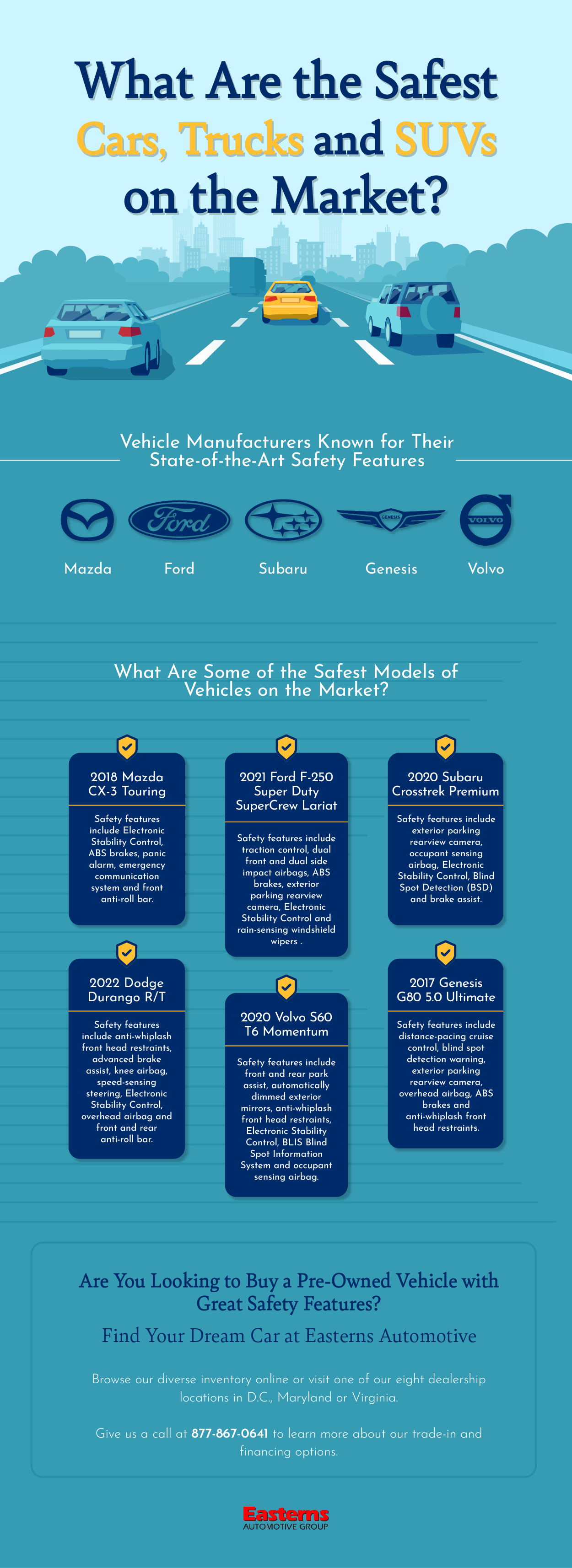
What Recommended Safety Features Should all Modern Vehicles Have?
It is because of crash data, safety ratings and technological advancement that additional safety features are added to newer vehicles. As manufacturers develop and build new cars, safety is one of their top priorities. Many pre-owned vehicles sold by Easterns Automotive include these recommended safety features.
Head-protecting airbags: Aside from frontal airbags, curtain air bags that deploy from above the windows prevent drivers and their passengers from hitting their heads or being ejected from the windows.
Antilock brake system: This system is designed to prevent the wheels from locking up under hard braking conditions, which helps prevent sliding or spinning.
Driver assistance: A car that is fully controlled by a driver (not automated) can also be equipped with numerous assistance features like blind-spot warning, automatic emergency braking, forward collision warning, adaptive cruise control and lane-departure warning. These systems are designed to prevent some accidents that might be caused by driver inattention or slow reaction times, increasing a vehicle’s accident-avoidance rating.
Electronic stability control (ESC): Vehicles manufactured in 2011 or later are required to have ESC to reduce spinouts if a driver loses control of the car. It may also help prevent a top-heavy vehicle from rolling over.
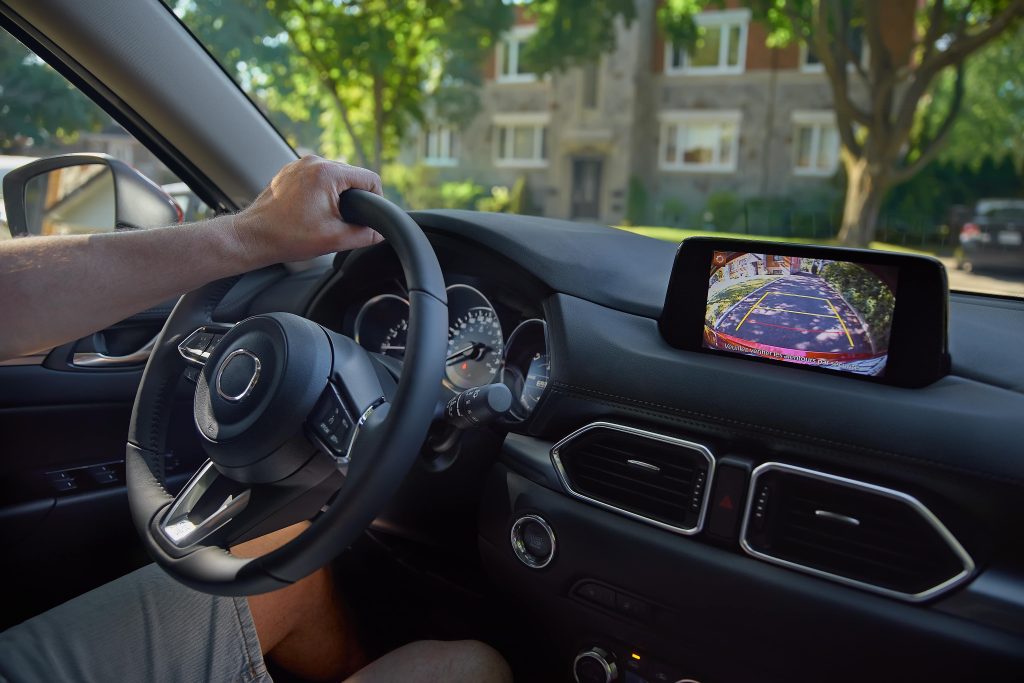
Rearview (or backup) cameras: When a vehicle is put in reverse, the backup camera reveals any objects that are directly behind the car on a screen, usually in the dashboard middle console. This gives drivers a clear view of what’s behind their vehicle and can reduce the occurrence of back-over accidents.
Find a Top-Rated Pre-Owned Vehicle in Maryland or Virginia
At Easterns Automotive, we understand there are a lot of important decisions to make when buying a newer car. We sell many recent model year pre-owned vehicles that are equipped with must-have safety features like ESC and driver assistance.
Our friendly customer care team can help make your car buying experience easy and memorable — no matter how you choose to do it. Whether you purchase your vehicle completely online, in-person or a combination of both, you can count on Easterns to show you why we earned an over 97 percent customer approval rating. Browse our inventory online and learn more about how we can help you find your dream car by calling us at 877-867-0641.
For decades, cars have been an essential part of everyday life, but their widespread adoption as the primary means of transportation didn’t happen overnight. Back when automobiles were first introduced to the public in 1886, cars were viewed as a luxury item that only the wealthiest households could afford. Today, over 130 years later, there are an estimated 1.4 billion vehicles in the world.
We rely heavily on cars to get us from point A to point B. Whether it’s work, school or soccer practice, reliable transportation is a necessity in our day-to-day lives.
It’s no surprise that there are many fascinating facts about these extremely complex yet very common pieces of vital property. Next time you find yourself chatting with a group of friends at a party or sitting around the dinner table with family, spark a conversation and show off your automobile knowledge with these fun facts.
The first full-size car was built in 1789 by French inventor Nicolas-Joseph Cugnot using water and steam pressure.
German engineer Karl Friedrich Benz (also known as Carl) invented the first modern car using three wheels and an engine located in the back. The Benz Patent Motorcar was first announced to the public in 1886 at an original cost of $150.
The Duryea Motor Wagon, introduced in 1893, was the first American-made gasoline-powered car. It was built by the Duryea brothers, Charles and Frank, using a $70 carriage and single cylinder-gasoline motor.
The Ford Model T, which was first made available by the Ford Motor Company in 1908, was the first affordable mass-produced vehicle. With a maximum speed between 40 to 45 miles-per-hour (mph), the Model T cost $825 (equivalent to $18,000 today).
BMW was first known as an aircraft engine manufacturer — the first product being the BMW III (a straight-six aircraft engine). BMW didn’t start making cars until they acquired a German automobile manufacturer in 1928.
On average, if you count every nut and bolt, a modern vehicle has 30,000 parts.
Austrian-German automotive engineer and founder of Porsche, Ferdinand Porsche, invented the first hybrid car in 1900 using an octagonal electric motor.
The three-point seatbelt we use today was invented by Swedish mechanical engineer Nils Ivar Bohlin when he was hired by Volvo. Thethree-point lap seatbelts were first introduced in Volvo cars in 1959.
The first muscle car (also known as a “supercar”) was released by General Motors in 1949. In order to be considered a muscle car, a vehicle needed to have a lightweight body, V8 engine and rear-wheel drive — all features that were designed for drag racing. The earliest muscle car on the market was the Oldsmobile 88, which went on to make NASCAR history.
The code inside an average car’s internal computer could stretch for 100 miles if printed on paper.
Car insurance was first implemented in the United Kingdom when Minister of Transport Herbert Morrison mandated the Road Traffic Act 1930.
Only 18 percent of Americans know how to drive stick shift, which might explain why only 5-percent of vehicles sold in the country are manual.
The fastest police car in the world is in Dubai. The Dubai Police Department’s fleet includes 14 supercars — the Bugatti Veyron being the fastest with a top speed of 253 mph.
The Ford Crown Victoria was the last vehicle to offer a cassette tape player in 2011.
The top selling car of all-time is the Toyota Corolla. Since it was first introduced by Toyota Motor Corporation in 1966, the manufacturer has sold an estimated 50 million Corollas.
Visit Your Local Pre-Owned Car Dealership in Washington D.C. and Baltimore
At Easterns Automotive, we take pride in maintaining an extensive inventory of pre-owned vehicles. Whether you’re looking to sell your car or trade it in for a more reliable vehicle, our team is here to ensure you receive a fair price and great financing services.
At Easterns, we do what we can to make the car buying process as easy as possible. Learn more about our trade-in offers and how we can help by calling us at 877-867-0641.
Inclusive Pathways to Success (IPS), founded by a Fairfax County mother, provides new skills and opportunities for differently abled students.
Naina Chernoff has a 16-year-old son that is autistic, and during the pandemic, she was concerned about his career prospectsNaina started the nonprofit to help teach young adults trade skills such as carpentry and woodworking, eventually transitioning to a career. The nonprofit offers students customized training that is paced for people with autism spectrum disorder, severe ADHD, learning disabilities, and mild intellectual impairment.
“I think I represent a population of parents who live at the mercy of other people’s kindness and empathy,” Chernoff explained. “I want to model the fact that our population of students are capable if we give them the right training and the right tools.”
Easterns Automotive Group’s Joel Bassam saw the great work IPS was doing and surprised them with a 7News Helping Hand.
“Inclusive Pathways to Success seems like an amazing organization, helping those young adults with varying disabilities to build their skill sets and hopefully find employment. We want to help you support those young adults by donating $2,200 to your cause to continue to help them out,” Bassam said.
Chernoff says more funds are still needed for a successful launch of their full-time program they hope to start in September 2023. They are still searching for a space to have by then, so the donation from Easterns Automotive Group couldn’t have come at a better time.
Over the years, you may have heard random myths, theories or “tricks” for enhancing your car’s performance or fuel efficiency. Many of these “tips and tricks” have never actually been proven, and some may be counterproductive.
As a car owner, do your best to decipher facts from myths. You (and your wallet) may be better off for it.
1. The bigger the car, the safer it is
Some drivers are led to believe that if they drive a larger vehicle like a truck or SUV that they will be much safer in the event of an accident. While some trucks can have higher safety ratings compared to sedans, they are also top heavy, which makes them more vulnerable to a rollover crash.
2. Filling your tank with premium fuel will enhance performance
High-end luxury vehicles and sports cars often require premium fuel in order to operate properly. However, if your car only needs unleaded gasoline, paying for premium is simply a waste of money. Unless you are driving a sports car that requires it, premium fuel will not enhance a car’s performance or responsiveness.
3. You should always warm up your car’s engine in the winter
While it is true that engines do need to warm up, that doesn’t mean you need to leave your car running idle for several minutes before you drive it. When you let it idle while you make your coffee in the morning, the car operates at its lowest power (which doesn’t generate as much heat). The best way to “warm up” your engine is to drive it.
4. Using your cell phone at the gas pump could trigger an explosion
This myth dates back to when mobile phones began to grow in popularity when some believed that wireless signals could spark and ignite fuel vapors. There is no scientific evidence or recorded incidents that point to the validity of this myth.
5. Running your air conditioning conserves fuel versus rolling down your windows
Have you ever been low on gas and panicked because it’s too hot to roll the windows down? Despite the weather, it is always better to shut off your car’s air conditioner and roll down the windows in that scenario. The myth that open windows hurt your fuel economy due to drag is not true. While drag does exist and may have a small effect on fuel efficiency, the air conditioning will always use more fuel than driving with the windows down.
6. Boost your car’s power by installing a performance chip
Drivers who are looking to “pimp their ride” might turn to aftermarket parts like performance chips to improve the quality of their vehicle. Although performance chips are marketed by manufacturers as a way to give your car more juice, they don’t actually make your vehicle more powerful.
These chips primarily just manipulate your vehicle’s computer-controlled components to make them perform differently. Some of the safeguards or limits that a performance chips override might have important purposes, which means using a chip could have adverse consequences for your engine.
7. You can charge your car battery just by jumpstarting it
There is nothing worse than realizing you have a dead battery right before you have to go to work or make it to an appointment. When this happens, you can either have the battery jumpstarted or you can buy a new car battery. Keep in mind that jumpstarting a car battery is only a temporary fix — the battery will still need to be replaced (and soon).
8. A car’s safety and technology features will compensate for bad driving habits
Features like driver assistance and backup cameras can give drivers more tools, visibility and warning signs to reduce the risk of accidents, but they can’t fix bad driving. Safety features like blind spot warning and adaptive cruise control are designed to increase accident-avoidance. At the end of the day, a driver can ignore all safety features and continue with their bad driving habits.
9. Hybrid vehicles are much slower
When hybrid vehicles first hit the market, they typically accelerated at a slower rate compared to an average vehicle. Over the last 10 years, manufacturers have improved hybrid models and equipped them to be more fuel-efficient and lighter in weight — both of which allow the hybrid powertrains to operate at an equal power as a regular sedan.
10. Manual transmissions are more fuel efficient compared to automatic transmissions
Remember there haven’t always been automatic transmissions. When they first hit the market, drivers realized they could get better fuel economy with a manual transmission. Of course, automatic transmissions have come a long way since then — some even providing a more fuel-efficient option when compared to manual transmissions.
Find Your Next Used Car at Easterns Automotive
If you live in the Maryland, Virginia or the Greater D.C. area, Easterns Automotive is your source for exceptional pre-owned vehicles. We’ve been serving D.C. and Baltimore car shoppers for more than 30 years and are committed to quality, affordability and flexible financing.
Give Easterns a call at 877-867-0641 or visit one of our eight dealerships today for more information.
Mario and Sharday Richardson lost their four-year-old daughter, Moriah, to brain cancer. The Richardsons’ wanted to give back to others experiencing the same thing, so they created the Forever Moriah Foundation.
They called it the forever Moriah foundation to give back and as a way for her name to live on forever. “I always want to have her memories to live on,” Sharday said, holding a picture of Moriah. “She’s not able to celebrate Christmas, but to have me, my husband, and family continue to give back in her honor – her name will literally live on forever. That’s why it’s the Forever Moriah Foundation.”
They work tirelessly to support children undergoing treatment for cancer. Every year they have a toy drive where they collect toys and donate them to the Ronald McDonald houses and the children’s hospitals in the area. It’s not just toys; they go above and beyond year-round, helping families make memories and give back financially.
Amazed by their work to help other families, we wanted to surprise Forever Moriah Foundation with a helping hand. Joel Bassam joined with a special message for Sharday and Mario.
“Unfortunately, it feels like cancer has touched everyone’s lives in one way or another, and the way that your family has turned loss into helping others [who are] fighting this incredibly difficult battle is amazing. We want to help you continue to help those who are going through such a difficult time by donating $2,200 to your cause so you can continue to bring joy to those families who are fighting cancer in such a difficult way. Thank you!”
The Richardsons were overwhelmed with gratitude by this surprise donation. Holding back tears, Sharday expressed how much it means to her and their foundation to continue to give back to others.
Jude Adler is a student from Fairfax County that is helping to feed those in need in his community. The 16-year-old launched a nonprofit called “Mummies for Mouths” that uses repurposed glass jars and turns them into mummy decorations using tape and eyes.
Adler, his classmates, and the community helped to create the mummy decorations and raise money to feed those in need since 2021.
“When we first broke $1,000, that was mind-blowing, and now here we are at $16,000 over two years,” Adler shared. His organization became an official local nonprofit after all their hard work, allowing them to help in many other ways. “We’re donating to multiple service organizations, and we can play a much larger role by applying for discounts at local stores,” Adler said.
On this 7 News Helping Hands, Joel Bassam with Easterns Automotive Group wanted to meet Adler in person because he had a surprise for “Mummies for Mouths.”
“We heard about your story and wanted to support you by donating $2,200 to your cause so you can keep feeding those in need,” Bassam said.
After receiving their surprise donation, Adler allowed Bassam to pick his mummy decoration from his collection.
About a month ago, a terrifying explosion occurred at an apartment complex in Gaithersburg, MD, leaving one person dead and dozens of families having to start their lives over. Across the street is Brown Station Elementary School, where students and staff jumped into action to help during this horrific tragedy.
The school has been receiving donations and giving them to those who lost everything in the explosion. They are now collecting gift cards so families can purchase what they need. We wanted to show our appreciation to the staff and students at Brown Station Elementary, so we took the time to Pay It Forward with Fox 5 DC. Easterns donated gift bags full of goodies as a token of gratitude for the work they have done in the community.
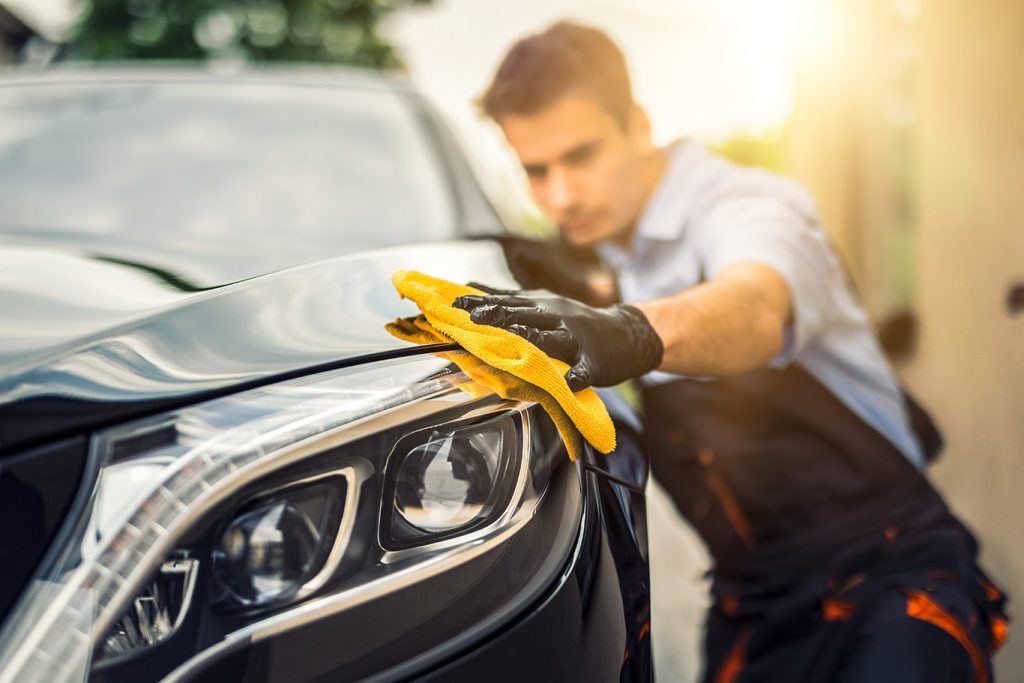
Car detailing – the man holds the microfiber in hand and polishes the car. Selective focus.
Detailing your car is a more in-depth process than your standard wash and will take longer and cost more than simply driving through a carwash. Despite the amount of time it can take, it’s still important to detail your car occasionally. Doing so helps maintain the appearance and value of your automobile.
To detail your car, it’s necessary to have the right equipment and patience. Detailing a car can take a lot of time, so many people choose to hire professionals to handle the process.
What Is Car Detailing?
Car detailing is a cosmetic process that restores the appearance of an automobile. Detailing a car may also include making minor cosmetic repairs to small damages to its interior and exterior. The focus of detailing is more on the appearance of the vehicle than mechanics. You should consider detailing your car every four to six months to keep it in its best condition.
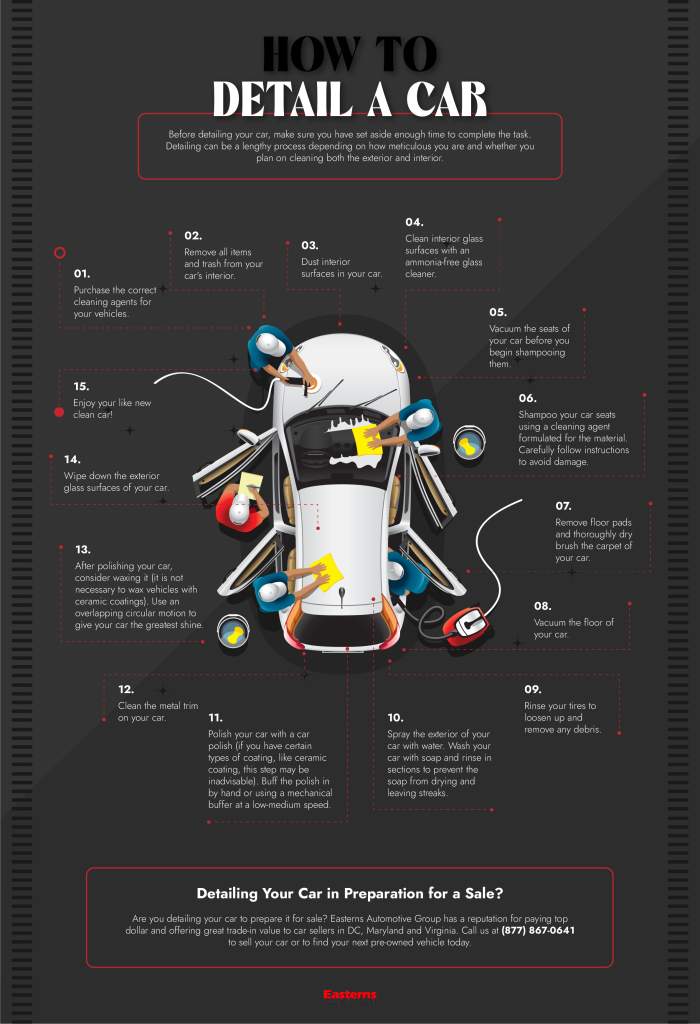
Setting aside time to detail your car will ensure you get the best results as you meticulously follow through on the steps needed.
Know What You Need
You’ll need different cleaning agents depending on the materials inside the interior of your car and its overall state of repair. Before you begin cleaning your car, make sure you have what you need. You may save yourself time and money by investing in a car detailing kit. With a premade kit you can be certain you have most everything you need to detail your car.
Bring two bins with you; one to hold items you’ll want to put back in your car after you’ve finished detailing it and one for trash. This can help you stay organized during the process of detailing the interior.
Start With the Inside
You’ll want to begin detailing your car from the inside out. This is the best way to ensure that any dust or debris from inside your car does not make it to the exterior of your car. Following this logic, while cleaning the interior of your car, begin from the top and work your way down.
Surfaces
Start by clearing out all unnecessary items from your car. Clean out your cupholders, ashtray, compartments etc. Put trash like receipts or other items you don’t want to keep in one bin. Use the second bin to keep safe items like your owner’s manual.
After you’ve removed all items from your car, begin dusting the hard interior surfaces. To do this, you’ll need compressed air spray, a towel or wipe and a bristle brush. Use the compressed air spray to purge dust out of difficult-to-reach places. Use the bristle brush to clean out your air vents.
Wipe all hard interior surfaces like your steering wheel using the proper cleansing agent for the surface. If your car has leather, use a commercial leather cleanser on a soft microfiber towel. If your car has a plastic or synthetic material interior, wipe with a damp microfiber towel first, then use a gentle cleaning agent on a towel. If this doesn’t work to remove all marks, try a gentle scrub brush. Then remove the cleaner with a damp towel and follow up with a dry towel.
Clean all glass surfaces in your car with an ammonia-free glass cleaner.
Seats
Vacuum the seats of your car, preferably using a brush head attachment. Alternate the heads when necessary to reach and remove all debris trapped in the tight corners of your car seats.
Spot treat deep stains with a strong cleaning agent and allow the agent to rest to loosen the stains.
Some cleaning agents for car seats need to be mixed with warm water to work. Follow the product label’s preparation instructions and then apply the shampoo to your car seats.
Scrub the seats after applying the shampoo with a soft brush. Be sure to focus on any stains. Rinse your brush off as it becomes dirtied in a bucket of water.
To dry your seats after shampooing them, use a soft towel to wipe away the moisture trapped in the seat materials. After wiping down the seats, park your car in the sunniest place you feel comfortable and leave your car doors open to allow the sunlight to dry up the rest of the moisture.
If your seats are leather, condition them after drying them and don’t let them sit in the sun. Carefully follow instructions on leather cleaning products to avoid damaging interior seats and surfaces.
Floors
Take off your floor pads and brush the carpet to loosen and remove any debris trapped in the fiber of your car’s floors. Use a softer brush to avoid damaging the carpet fibers of your car while you detail it.
Vacuum your floors. Your vacuum should come with multiple head attachments. Change the attachments when necessary to reach debris in all corners of the flooring of your car. Shift your seats all the way forward and backward to ensure you reach everything.
Clean The Exterior
Tires
Rinse off your tires and rims first to remove any loose debris. After that, apply wheel cleaner and allow the cleaner to sit for a minute.
Scrub your tires using a brush then use a wheel cleaner. After you’ve washed your tires, apply a protectant to prevent any damage to your tires.
Spray the exterior of your car with a hose to rinse it off.
Use a sponge or a car mitt and soap to wash your car in sections. Washing and rinsing your car in sections will prevent the soap from drying on your car and forming swirl patterns.
Soak the sponge or car mitt in water to remove any soap and rinse the soap off your car as you move along. Following this, dry each segment of your car with a soft microfiber towel.
Use a clay bar to remove any contaminants that might be stuck to the surface of your car.
Polish (If Appropriate)
Cars with graphene or ceramic coatings may not require polishing or waxing. It may be necessary to skips these steps if your vehicle has a protectant layer already applied.
Apply polish to your car in small doses and buff out the polish using a power buffer at low to medium speed or with a buffing pad.
After buffing, use a dry towel to wipe off any excess polish and dry your car.
Clean the metal trim of your car by applying a metal cleaner and wipe it down with a dry towel.
Wax
After polishing your car, take a small amount of liquid car wax on an applicator and begin spreading the wax across your car in an overlapping circle motion.
Glass
Wipe down the exterior glass of your car by using a glass cleaner. Spray the glass with the glass cleaner and then use a dry towel to wipe the cleaner off.
How long it takes to detail your car depends on how deep of a clean you’re aiming for and the state of the car when you begin detailing it. Detailing a car can take anywhere from two hours to two days depending on whether you want to clean just the interior or the interior and exterior.
It can be a big task to tackle on your own and there are professionals who can provide you with the level of service you need.
Easterns Automotive Group is the number one used car dealership for D.C., Maryland and Virginia. We have been helping all types of car shoppers find great pre-owned vehicles for more than 30 years.
Our customers can choose if they want to sell online, in-person, or a mixture of both. If you’re detailing your car to prepare it for sale, consider using our 100-percent online car sale option. Contact us to learn more about our used car inventory or look over ourinventory online.
Used car dealerships receive a near consistent flow of new inventory. They receive their car inventory one of two ways, from auctions or from trade-ins. Your used car dealership might see new stock as often as every day depending on their buying practices. Keep an eye on used car dealership inventories because of how often they can change, especially if you’re on the lookout for a specific make or model of vehicle.
Auction
A dealership can get their used car inventory from two different types of auctions. One type is closed to the public and is held by car manufacturers. Closed auctions held by car manufacturers are where car manufacturers sell their stock of used cars.
These cars were often leased by the car manufacturer. Leased cars, sometimes referred to as “program” cars, are usually high-quality and kept in good condition. Maintenance is often part of the leasing program.
Another way that auctions receive inventory to sell to dealerships is through repossession. If the owner failed to keep up with their car payments the lender (via a repo company) may repossess the car and then sell it at an auction.
This type of auction is usually reserved for used car dealerships that are franchisees of the manufacturer. Cars that don’t sell at these auctions might be pushed forward to open auction.
Open auctions are available to any licensed car dealership. The used cars sold here can come in a wide variety of conditions. Some cars sold at an open auction can be relatively new with little mileage while others can have high mileage and be undriveable. Cars bought at an open auction are bought at the car dealership’s discretion. Oftentimes, car dealerships will use these auctions to both buy and sell their used car inventory.
When buying a used car, you might want to know where your car dealership bought the vehicle. A closed auction will usually have a higher quality of car than an open auction, but not always.
Trade-In
If you’re buying a new car, you might choose to trade in your previous car. This is the second way that car dealerships receive their inventory and one of the main reasons why used car dealerships almost always have new inventory.
Vehicles that were traded in can come in all sorts of states, similar to open auction vehicles. If a dealership doesn’t think they can sell a vehicle they might auction it off at an open auction. If a car is a fairly recent model year and in good enough condition, a used car dealership will likely recondition the car and sell it on their lot.
Buying your next car from an established dealership can help you avoid trouble further down the road.
When you trade in your car, the car dealership will offer you either a cash payment or they will ask if you’d like your trade-in value to be applied to the purchase of your next vehicle. Doing so may allow you to maximize the equity you have in your existing vehicle and put it toward the purchase of your next car, truck or SUV.
In general, you will want to trade in your vehicle at the same location that you plan to buy your next car from. Car dealerships will buy almost any vehicle because of the many ways they can sell it in the future, whether through an open auction or on their own lot.
Buy From a Dealership You Can Trust
Easterns Automotive Group is a family-owned business that has been operating in the D.C., Maryland and Virginia areas for more than 30 years. We are a top-rated used car dealership with over 48,000 five-star reviews.
You can buy a used car from us comfortably knowing that we carefully vet and select the cars on our lot to suit your personal needs. Our dealership uses a strict multi-point certification check to ensure that our customers can buy their next car with confidence.